
How Electromagnetic Shielding Fabric Works and Its Uses

Introduction
Are you looking for electromagnetic shielding fabric and its uses? Yes, the textile trainer will brief on the mechanism of electromagnetic shielding fabric. Electronic devices are now part and parcel of our daily lives. To cite an example, mobile phones, Wi-Fi, laptops, radar systems, etc. All the communication devices produce electromagnetic waves. This electromagnetic weave is called electromagnetic interference (EMI). This EMI may disturb nearby electronic equipment. It also affects the human body. It helps reduce this problem. This fabric blocks or weakens the electromagnetic waves. It is widely used in military products, protective clothing, smart textiles, and medical devices.
What is Electromagnetic Shielding Fabric (EMI)?
Electromagnetic Shielding Fabric (EMI) are specially designed fabric which reduce electromagnetic interference (EMI), radio frequency interference (RFI) and electromagnetic radiation. It also known as EMI shielding Textiles. It plays and important role in electromagnetic interference shielding, advance sensing and communication technologies.
What is Electromagnetic Shielding (EM) Textile?
Electrically conductive textiles are built by incorporating metallic wires, conductive polymers, or other conductive compounds into the textile structure during fiber construction, yarn spinning, and fabric manufacturing.
The Mechanisms of Electromagnetic Shielding Fabric
EM shielding works mainly reflection and absorption. Besides those it also works by multiple reflection and grounding also. Those are given below:
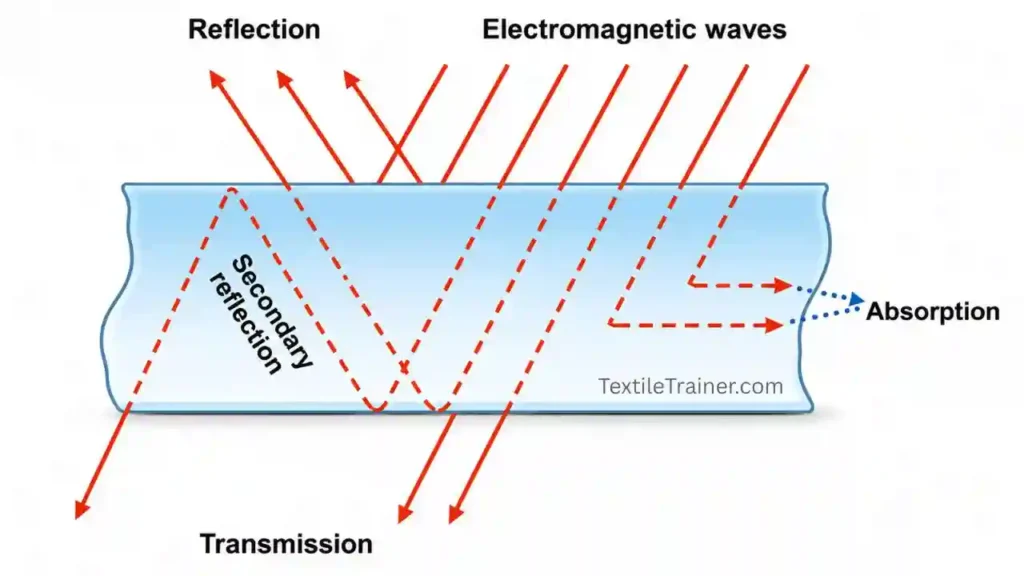
- Reflection: It reflects waves when the EM waves encounter a conductive surface (metals).
- Absorption: Conductive materials absorb EM energy as heat through polarization and iron conduction.
- Multiple reflection: It also scatters waves inside the textile material
- Grounding: Some times electromagnetic shielding (EMI) fabric dissipate electrical energy to the ground directly.
You may read: 3D Knitting Technology: An Innovation in Modern Textile
EMI Shielding Materials
- Metals
- Copper: The excellent electrical conductivity of copper makes it an excellent material for EMI shielding. Copper can be formed into various shapes(Example: foils, sheets, and meshes)
- Aluminum: Sometimes, aluminum is used as an alternative of copper. It offers good shielding performance. It is less expensive. But it is less conductive than copper.
- Tin-plated steel: Tin-plated steel is another EMI shielding material. Tin-plated steel sheet offers excellent corrosion resistance as well as shielding properties.
- Nickel: Nickel also used for electromagnetic shielding fabric materials. Generally, the nickel foil is commonly used in aerospace and military applications.
- Conductive paints: Typically, these are made up of suspended graphite or silver particles in a solvent. This conductive paint can be applied to surfaces of the fabric. Hence, it creates conductive shields.
- Conductive Gaskets and Seals: The purpose of these seals is to prevent EMI leakage from seams of the fabric. It also prevents openings in enclosures.
- Ferrite sheets: They are made of magnetic materials like iron or nickel. It absorbs electromagnetic radiation, reducing EMI. Ferrite sheets are used in high-frequency devices.
- Conductive polymers: These are composite materials incorporating conductive fillers (example: carbon nanotubes) into a polymer matrix. Conductive polymers are lightweight. It also flexible shielding materials.
- Hybrid Materials: Shielding materials can combine multiple approaches. Shield fabric is made with materials such as metal-coated plastic or fabrics with conductive coatings.
Electromagnetic Shielding Fabric Properties
- Electromagnetic shielding fabric should have good electrical conductivity.
- It should have the ability to block the electromagnetic waves.
- It should be a lightweight structure and have enough flexibility.
- It should be comfortable to wear and have good durability.
Importance of EM Shielding
- It protects us from Electromagnetic (EM) radiation from electronic devices poses
- It reduces risks of human health
- It reduces the risk of electronic systems.
- It makes a flexible and breathability fabric
Application of Electromagnetic(EM) Shielding Textile
Electromagnetic Shielding fabric is primarily applied for blocking radio waves, microwaves, or EMI in high-frequency devices such as smartphones, medical equipment, etc. The application of EMI fabric is given below.
1. Military and Defense
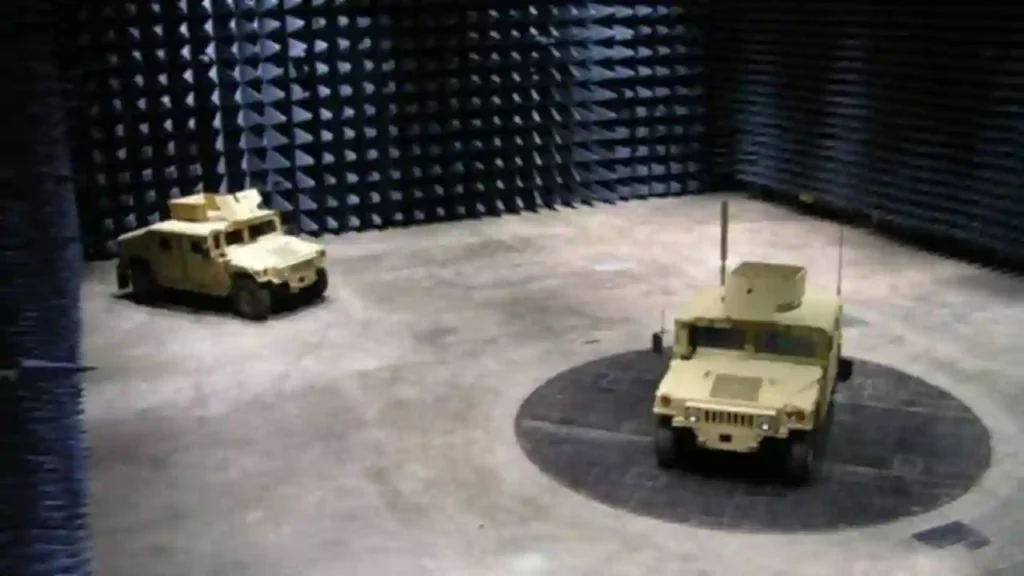
EMI is widely used in military uniforms and gear to protect personnel from electronic eavesdropping and signal jamming. It prevents electromagnetic interference (EMI) and make secure communication devices and radar systems in defence. In military and defence sector EMI is used in radar shielding, Stealth technology, aircraft communication systems and satellite electronics.
2. Medical Equipment and Human Safety
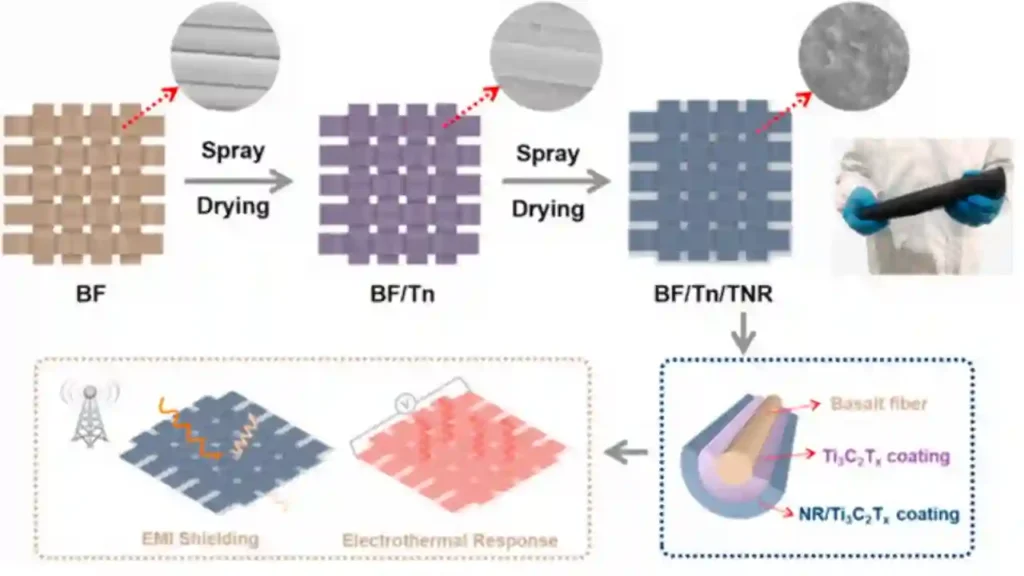
EMI fabric shields patients and sensitive electronics from external RF interference of MRI machines and its surrounding area. It also helps human safety from long term exposure to electromagnetic radiation from different high frequency devices.
3. Consumer Electronic
EMI textiles resists interference from EM sources in high EM environments such as smartwatches, smart mobile phone etc.
4. Industrial Applications:
EMI textile protects machinery and control systems in factories from high frequency equipment such as EMI from power lines, motors etc.
5. Aerospace and Automotive:
EMI textile is also used in aerospace and automotive. It keeps the aircraft safe by protecting aircraft avionics and cockpit electronics from electromagnetic interference.
6. Automotive:
EMI textiles are also used in insulating electric vehicle components such as batteries, charging systems, etc., from arcing and RF disturbances.
Electromagnetic Shielding Fabric Advantages
- Electromagnetic shielding fabric reduces electromagnetic interference.
- It protects sensitive electronic devices.
- It is lightweight and flexible. Hence, it is suitable for wearable applications.
- It is useful in many industries.
Limitations of electromagnetic shielding fabric
- In electromagnetic shielding fabric, extra conductive materials are used. Hence, it increases the production cost of fabric.
- Sometimes coating materials are sprayed on fabric. In many cases, the coating loses its performance after washing.
- Havey metal content is used to make EMI shield fabric. Hevey metals content reduces the comfort.
- Electromagnetic shielding fabric manufacturing process is complex.
Conclusion
At the end, electromagnetic fibres are a field of materials science applied in textiles, where advanced physics and textile engineering areintegrated to produce the next generation of materials for smart devices, healthcare, and more applications. Its effectiveness depends on the conductivity, thickness, and the number of waves of incident EM waves. It will create a new era in the smart textile application day by day. More research is required to make it lightweight and more flexible.
You may read: 3 Easy Step of Non-woven Fabric Manufacturing Process
FAQs
- What is Electromagnetic shielding fabric?
- Electromagnetic shielding fabric is a conductive textile material. It blocks or reduces electromagnetic radiation from the surrounding environment.
- How does EMI fabric work?
- EMI fabric reflects or absorbs the electromagnetic waves by using conductive materials.
- Which metals are used in shielding fabrics?
- EMI shielding fabric’s materials are copper, nickel, silver, and steel..
- Where is electromagnetic shielding fabric used?
- EMI fabric is used in protective clothing, smart textiles, medical textiles and military products.
Reference
- A review of electromagnetic shielding fabric, wave-absorbing fabric and wave-transparent fabric,J Yin, W Ma, Z Gao, X Lei, C Jia – Polymers, 2022 – mdpi.com
- Electromagnetic shielding characterisation of several conductive fabrics for medical applications RR Bonaldi, E Siores, T Shah – Journal of Fiber …, 2010 – journal10.magtechjournal.com
- Textile fabrics as electromagnetic shielding materials—a review of preparation and performance T Blachowicz, D Wójcik, M Surma, M Magnuski… – Fibers, 2023 – mdpi.com
- Textile materials for electromagnetic field shielding made with the use of nano-and micro-technology S Brzeziński, T Rybicki, I Karbownik, G Malinowska… – Open Physics, 2012 – degruyter.com
- A waste textiles-based multilayer composite fabric with superior electromagnetic shielding, infrared stealth and flame retardance for military applications Y Zhang, G Shen, SS Lam, S Ansar, SC Jung… – Chemical Engineering.
- https://www.emrss. com


It is helpful for smart textile processing
Thank you….
Thank You
Thanks too.