3 Types of Shedding Mechanism in Weaving Loom
What is the Shedding Mechanism?
This article is about types of shedding mechanisms and their advantages and disadvantages. Before, let’s come to learn the definition of shedding mechanism. During weaving, warp yarns are separated into two layers to insert the weft yarns. This separation is called a shed, and the mechanism of the shed is called the shedding mechanism. Different types of shedding mechanism uses in the weaving section. Types of shedding mechanisms are used depending on fabric types, the type of loom, and the production speed of the loom. Every mechanism has its own advantages and disadvantages.
Types of Shedding Mechanism
There are three types of shedding mechanisms are used in weaving section. They are:
- Tappet Shedding Mechanism
- Dobby Shedding Mechanism
- Jacquard Shedding Mechanism
1. Tappet Shedding Mechanism
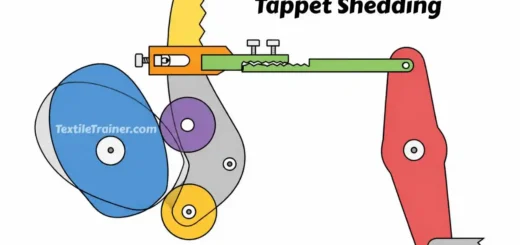
Different heald shafts are used to draw warp yarn ends into them, and their movements are controlled together to create the shed. There are cams on the bottom shaft that drive each heald shaft, and they are fixed in a synchronized fashion. For the tappet-shedding mechanism, the cam profile determines how the heald shaft moves. The tappet-shedding mechanism is also known as the cam-shedding mechanism because it involves cams. They are two types of tappet shedding mechanism:
- Negative tappet shedding
- Positive tappet shedding
Negative Tappet Shedding
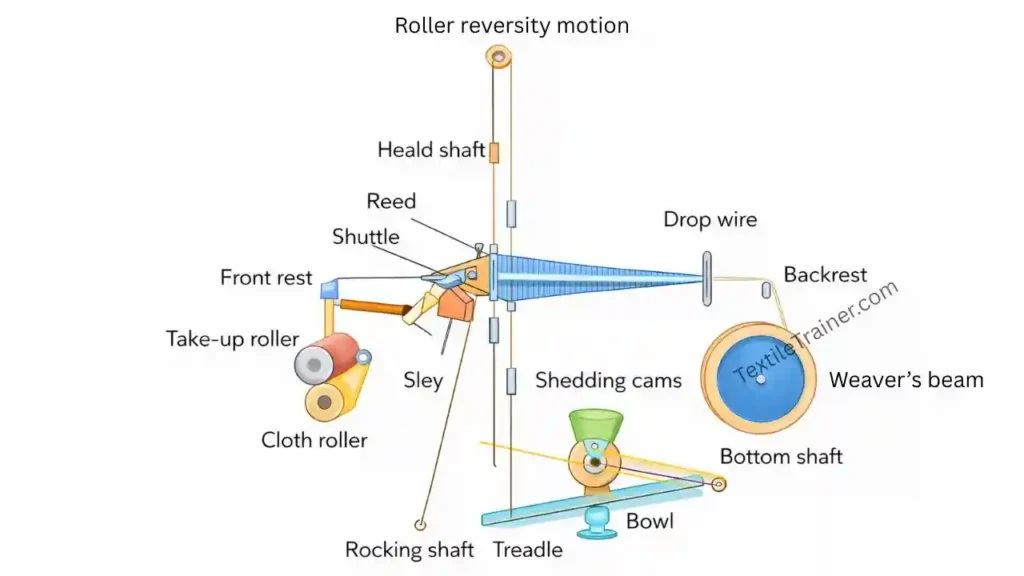
Various parts of a loom fitted with a negative tappet-shedding mechanism are shown in figure 1. The shedding cams (tappets) are rotated by the shaft at the bottom. As the tappets rotate, they depress “followers” (anti-frictional bowls), which are attached to the treadle levers and centered at the back of the loom. Through cords, the lower ends of the heald shafts are connected to the treadle levers, while the top ends are connected to a reversing roller device, which consists of two rollers with different diameters. By rotating the cams, the bowls are depressed, depressing the treadle levers and the heald shafts. By using the roller reversing action fitted at the top, the downward drive given to one shaft generates upward movement for the other shaft, which results in positive action.
Positive Tappet Shedding
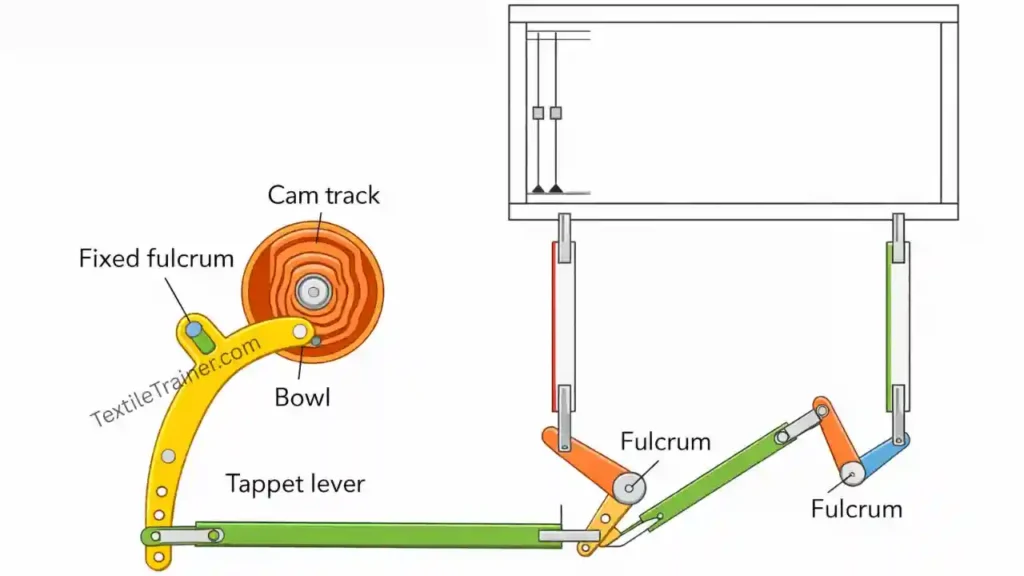
There is shown in Figure 2 a positive cam-shedding mechanism. A cam with a groove is attached to the camshaft. A bowl fits in the groove. The shafts are connected with appropriate connecting rods to one end of the cam lever with a fixed fulcrum. As a result of the camshaft’s rotary motion, the bowl follows the groove path when moving, transmitting the motion to the link rods, which then transmit the motion upwards or downwards to the shafts, based on where the bowl is in the grooved cam. It is classified as positive shedding because the cam controls the upward and downward movement of the heald shaft. There are as many cam units as there are working heald shafts. Depending on the loom design, the tappet- or cam-shedding mechanism can be located inside or outside.
Advantages
- Tappet shedding is simple and cheap.
- This type of shedding mechanism is capable a heavy weight with less wear and tear compared to other shedding mechanisms.
- It needs less maintenance cost.
- It is capable of moving shafts at high speeds.
- The warp is not subjected to as much stress.
- It consumes less power and produces more.
Disadvantages
- Change of weave requires changing the tappet and the change gear wheel in the counter shaft arrangement, so there is more work involved.
- Only 8 or 10 tappets can be used to produce a pattern/weave.
2. Dobby Shedding Mechanism
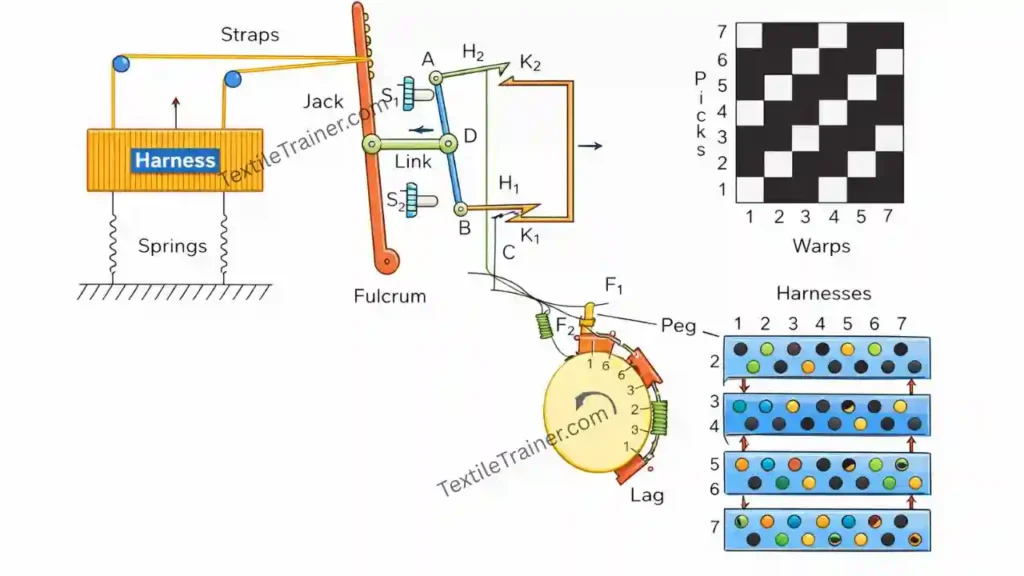
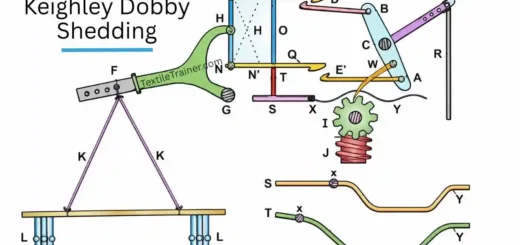
Modern high-speed weaving machines have required significant improvements in the design of dobby-shedding mechanisms over the past 150 years. Modern dobby mechanisms offer a considerably greater scope than most other mechanisms. They are used in the production of simple figured fabrics. Dobby mechanisms can be divided into two categories: the single lift mechanism and the double lift mechanism, or the positive lift and the negative lift mechanism. The single-lift dobby provides a bottom closed shed, while the double-lift dobby creates an open or semi-open shed. The positive dobbie weaves medium- to heavy-weight fabrics, whereas the negative dobbie weaves light- to medium-weight fabrics, which tend to be simpler. Figure 3 illustrates a negative dobby mechanism. The shafts are pulled up by the shedding mechanism, but are normally lowered by springs. The dobby mechanism raises and lowers the shafts in positive dobby shedding
Advantages
- It is possible to weave highly complex and critical fabrics.
- Several frames can be controlled at once
- Faster than positive dobby and conventional looms
- Produces close-bottom sheds
Disadvantage
- Only lowering of the shed is possible in this shed
- As a result of more stress, yarn breaks more frequently
- Heavy fabrics should not be used with it
- The loom does not receive more high-speed from it
3. Jacquard Shedding Mechanism
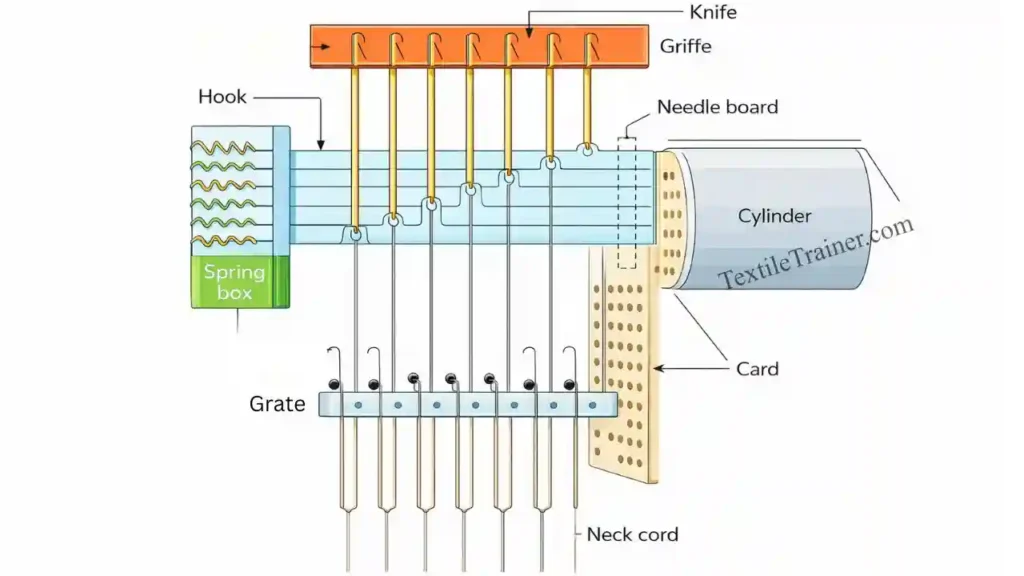
Jacquard fabric is a fabric in which a large number of warp threads, exceeding the capacity of a dobby, weave differently, thus requiring a jacquard mechanism. During tappet and dobby shedding, the heald wires are not operated separately but are attached to heald frames, or shafts, and the ends of the warp are raised and lowered together. With these two shedding systems, the number of shafts is relatively small, with a dobby controlling a maximum of 32 shafts. In jacquard shedding, however, heald wires are manipulated individually through harness cords, not collectively through the agency of a heald frame. Figure 4 illustrates a mechanical jacquard-shedding system. The shedding mechanism is mostly mounted on top of the locomotory.
Advantagaes
- In contrast to dobby shedding mechanisms, jacquard shedding mechanisms can produce large and intricate weave designs.
- Jacquard weaving allows individual control of each warp yarn.
- There have been many specialized jacquard machines developed for weaving particular types of fabric, such as terry towels, damasks, and carpets.
- In general, most of the rest are easy to categorize general purpose types.
Disadvantages
- High cost compared to other shedding mechanisms.
- Jacquard shedding mechanism is complex.
- Knives with reciprocating motions cannot be operated at high speeds.
- The repeated bending of hooks away from knives may lead to fatigue-induced faults.
In weaving, the shedding mechanism is an important factor. Tappet shedding is suitable for simple fabrics, dobby shedding provides moderate design flexibility, and jacquard shedding is suitable for complex fabrics. Fabric design, cost, and production requirements determine the shedding mechanism.
References
- Arora, J. (2011). Modern Weaving Technology. Delhi: Abhishek Publications Chandigarh.
- Fox, T. W. (1992). The Mechanism of Weaving. Bombay : Universal Publishing Corporation .
- Murphy, W. (2009). Handbook of Weaving. Delhi: Abhishek Publicaitons Chandigarh.
- V. Gordeev, P. V. (1982). Cotton Weaving. Russia: Mir Publishers Moscow.
You Read: