Wool Fiber Fineness Test by Optical Method Easy Way
Experiment Name
Determination of wool fiber fineness test by optical method./ Study on how to wool fiber fineness test by using a projection microscope.
Introduction
Wool fiber fineness is one of the crucial physical properties of wool. In textile products, fineness is one of the most important properties of fibres. It affects yarn and fabric properties in several ways. A finer fibre produces a finer yarn, which in turn produces a finer fabric. The finer the fibre, the finer the yarn. As the yarn becomes thinner, the number of fibres in its cross-section decreases and the yarn becomes increasingly uneven because the presence or absence of a single fibre has a greater impact on the yarn diameter. A coarser fibre will reach its spinning limit earlier, while for a yarn of a given linear density, a finer fibre will produce a more even yarn. The following methods are used to measure the fineness of fiber:
- Gravimetric method
- Optical method (Projection microscope)
- Unidimensional method
- Bidimensional method
- Air flow method
However, the wool fiber fineness test will be done by the projection microscope method in this experiment. The optical method is a laboratory technique. A projection microscope is used to measure the diameter of individual wool fibers.
Objective
- To know about the fiber fineness.
- Come to learn the fiber fineness test method.
- Understand the projection microscope method for wool fiber fineness test.
Principle of the Projection Microscope
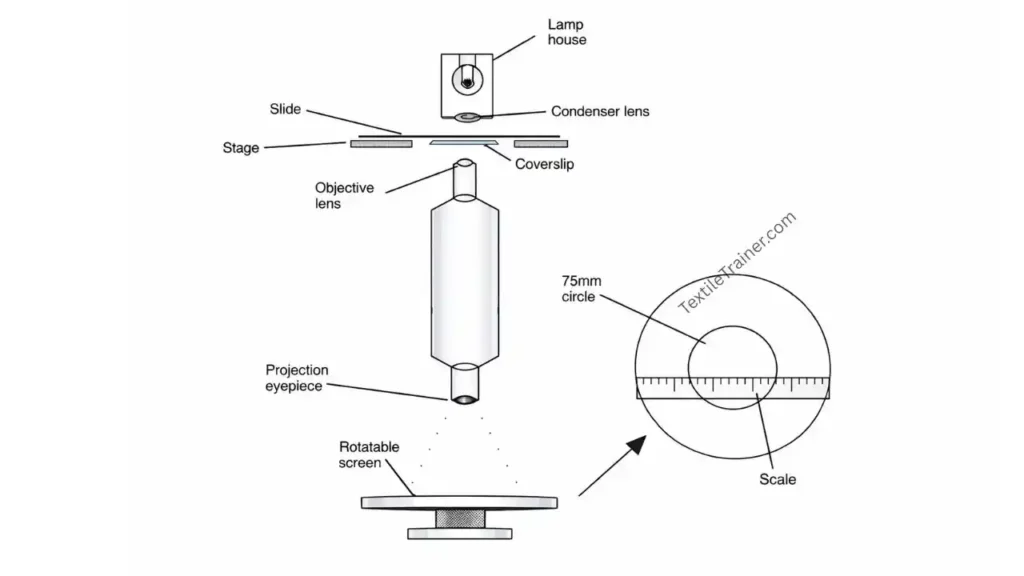
Generally, wool fibre diameter is measured with the projection microscope, and all other methods must be checked against it for accuracy. The method can also be applied to fibers with circular cross-sections. A microscope slide is prepared of short lengths of fibre, which are then viewed with a camera that projects a horizontal image of the fibres for easy measurement. Figure 1 illustrates the apparatus diagrammatically. The enlarged image of the fiber is projected onto the monitor of the computer. Now, the diameter of individual fibers is measured using a calibrated micrometer scale. Several readings are taken. Then the average diameter is calculated. A truly random sample is ensured by using techniques that avoid bias.
Testing method
- AATCC 20A
- GB/T 16085
- GB/T 16988
- FZ/T 30003
- SN/T 0756
Apparatus
- Projection microscope
- Light source
- Glass slide and cover slip
- Tweezers
- Micrometer scale
- Microtome
- Wool fiber
- Paraffin
Sample preparation
- A suitable random sample is conditioned for 24 hours in standard testing atmosphere.
- The wool fibers are cut to a suitable length ( 0.4mm for fibers below 27µm) by using a microtome.
- Sample cut fibers are kept on the glass slide, and the fibers are mixed into the mountant. The mounting agent should be non-swelling and have a suitable refractive index. Liquid paraffin is suitable for a mounting agent.
- The mixture of fibers, and mounting is spread thinly on the slide.
- Now, fibers are covered with a cover glass to avoid air bubbles and fingerprints.
- Finally, the sample is ready for testing.
Wool fiber fineness test procedure
- Initially, the prepared glass slide with wool fiber is placed on the stage of the microscope.
- Now, open the wool fiber fineness test software.
- Then click new test with the mouse and enter the test parameters, and click “Save”.
- Select the currently used lens (4x, 10x, 20x, 40x, and 100x). Then click the fiber(cotton, wool, Nylon, polyester, etc.) to be observed.
- Next, click the “Freeze”.
- After the image is frozen, select the “Measure” button and draw the diameter on the frozen image. Then click the “complete” button. The data will be updated in the left table in real time.
Test report
Observation Table
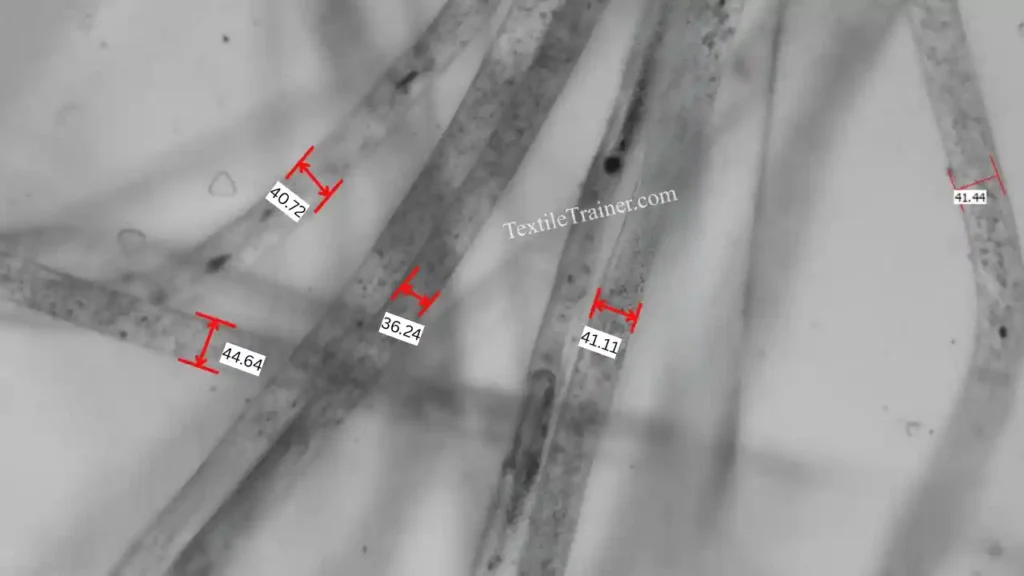
| Observation No | Fiber Diameter (µm) | Proportion (g/cm3) | Linear density (D) |
| 1 | 41.11 | 1.32 | 15.77 |
| 2 | 44.64 | 1.32 | 18.60 |
| 3 | 36.24 | 1.32 | 12.25 |
| 4 | 40.72 | 1.32 | 15.47 |
| 5 | 41.44 | 1.32 | 16.02 |
Wool Fiber Fineness Calculation
| Observation no | Content% | Avg (µm) | S | CV% | Max. (µm) | Min. (µm) | Proportion (g/cm3) |
| 5 | 100% wool | 40.83 | 2.69 | 6.58 | 44.64 | 36.24 | 1.32 |
Precautions
- The test specimen must be straight and not twisted.
- The glass slide must be clean.
- Measure a sufficient number of fibers for accuracy.
Conclusion
The wool fiber fineness test has been done successfully using the optical method. The average diameter was calculated in microns. This experiment will help in our future life. Thanks, our teacher for helping us to do the experiment.
References
- Booth, J. (2008). Principles of Textile Testing. New Delhi: BS Publishers & Distributors.
- P. Angappan, R. G. (2009). Textile Testing. Tamil Nadu: S.S.M. Institute of Textile Technology.
- Machine manual of wool fiber fineness tester GT-B17B provided by FYI