ICI Pilling Box Tester for Knit Fabric Pilling Test: ISO 12945-1
Experiment Name
Study on ICI pilling box tester for the knit fabric pilling test./ Study on how to determine fabric abrasion resistance by using ICI pilling box tester.
Introduction
A pilling fault is caused by entangled fibre clinging to the fabric surface and giving it an unsightly appearance. A pill forms when loose fibres protrude from the fabric surface and become entangled during wear and washing. Upon rubbing, these loose fibres form small spheres that are anchored to the fabric by a few unbroken fibres. The colour of the pills may differ from the colour of the body of the garment if stray foreign fibres become part of the pills. In fabrics such as woollen knitted goods with soft twisted yarns, pilling has long been acknowledged as a fault; however, the introduction of newer man-made fibres appears to have exacerbated the problem.
The reason is that wool has relatively weak fibres that anchor the pills to the fabric, and they break away fairly easily, whereas fibres such as Terylene, Orlon, nylon, etc., are strong, and the pills remain attached to the garment, accumulate, and become increasingly unsightly over time. However, there are three types of fabric pilling test machines used.
- Martindale Abrasion Tester: Flat abrasion as specified in the ASTM D4970 pilling test. The instrument subjects specimens to a rubbing motion in a straight line that widens into an ellipse and gradually changes into a straight line in the opposite direction. This pattern of rubbing is repeated until fabric treads are broken or until a shade change occurs in the fabric being tested.
- ICI Pilling Box Tester: specimens are mounted on the polyurethane tubes and tumbled randomly in a cork-lined box for a certain time.
- Random tumble pilling test: The specimen is placed in a cylindrical chamber and tumbled around within the chamber, which is lined with mildly abrasive materials to brush the specimens to free fiber ends.
Basically, the Martindale abrasion tester is used for woven fabric, and the ICI pilling box tester for knit fabric. Additionally, the random tumble pilling tester applies to most woven and knitted fabrics, including napped fabrics like fleeces and inlay fabrics. This experiment used an ICI pilling box tester for the knit fabric pilling test.
Lab report on Single Fiber Strength Calculation Easy Way
Objective
- To know about the pilling resistance of fabric.
- Come to learn about the fabric pilling test.
- To understand the ICI pilling box tester.
- To know the sample preparation and fabric pilling test procedure.
Testing Method
ICI pilling box tester follows the below testing methods.
- GB/ T 4802.3-2008
- ISO 12945-1
- BS 8479 standard
Apparatus
- ICI pilling box tester
- Polyurethane test specimen tubes
- Mounting jig
- Self-adhesive polyvinyl chloride (PVC) tape, ( 19±1 mm wide)
- Sewing machine
- Knit fabric
- Scissor
Preparation of test specimens
1. Pre-treatment of the laboratory sample
The test specimens can be pre-treated by washing or dry cleaning before cutting. Pre-treatment process is carried out according to the fabric end use or according to conditions agreed upon by the parties concerned. In case of pre-treatment, the tested specimen is compared to the pretreated laboratory sample when evaluating the pretreated specimen. In the absence of a specific pretreatment agreement between the interested parties, test specimens are tested as received.
2. Sampling of test specimens
Take specimens from evenly spaced areas across the width of the fabric or from three different panels of a garment. Stagger specimens so that no two specimens contain the same yarns. Avoid areas with wrinkles and other distortions. The specimen should not cut closer to the selvedge than one-tenth the fabric’s width, and handled with minimal tension to avoid stretching. Four test specimens, each measuring 125mm x 125mm, should cut from the laboratory sample. If a fabric does not have a discernible face, test both sides and mark the back of the fabric and its length direction on each test specimen.Now, mark 12 mm from the edge of the specimen as seam allowance.
3. Number of test specimens
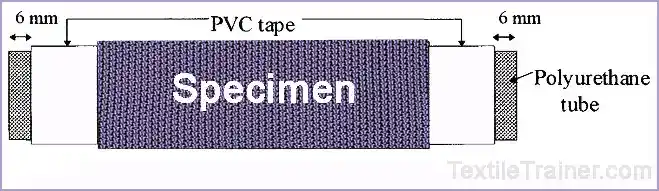
Make two test specimens by folding their faces inward, and running the machine direction in the direction of the fold. Sew (12±1) mm away from the cut edges to form a tubular shape, using a stitch density that produces a balanced seam. The other two test specimens should prepare similarly, with the cross-direction running in the fold direction. Now, use PVC tape to both sides of the tube to prevent any threads from coming out from the fabric edges. Follow the figure 1 for proper placement.
Lab report on Pressley Tester for Fiber Bundle Strength Calculation
Conditioning and Testing atmosphere
Test specimens in their tubes should condition for at least 16 hours before testing in the standard atmosphere described in ISO 139 (Standard atmospheres shall have a temperature of 20°±20C and a relative humidity of 65±2%).
Working Procedure of ICI Pilling Box Tester
- At first, check the pilling box carefully. Ensure the box is clean and free of wool fibers or other foreign materials.
- Now, place the prepared specimen into the sample loading tube. Insert the loading tube into the pilling box.
- Then, close the cover properly and fasten the lock securely to prevent accidental opening during machine operation.
- Then, plug in the power cord and switch on the machine.
- Subsequently, set the required number of revolutions according to the buyer’s agreement. If no specific agreement is available, set:
- 7,200 revolutions for coarse fabrics.
- 14,400 revolutions for fine imitation fabrics.
- Now, press the Start button to begin the test. Then, the machine will rotate according to the preset value.
- Finally, the machine will stop automatically and give an alarm when the preset number of revolutions is complete.
- After completion, open the cover carefully. Remove the loading tube and take out the specimen.
- Then, remove the stitches and unfold the specimen gently.
- Now, compare the tested specimen with the standard photographs(standard pilling images) in the standard light source cabinet.
- Finally, evaluate and record the pilling grade to the nearest 0.5 rating.
Fabric Pilling Test Evaluation
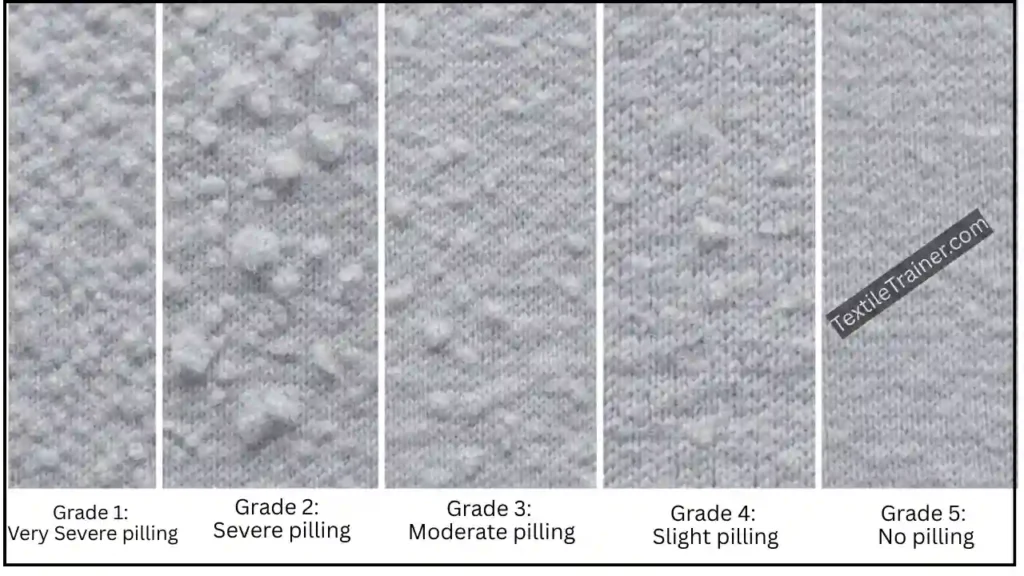
The table below provides a visual assessment of the knit fabric pilling test report.
| Grade | Description |
| 5 | No change |
| 4 | Slight surface fuzzing and/ or partially formed pills. |
| 3 | Moderate surface fuzzing and/or moderate pilling. Pills of varying size and density partially covering the specimen surface. |
| 2 | Distinct surface fuzzing and/or distinct pilling. Pills of varying size and density covering a large proportion of the specimen surface. |
| 1 | Dense surface fuzzing and/or severe pilling. Pills of varying size and density covering the whole of the specimen surface. |
Conclusion
The ICI pilling box tester use to evaluate the pilling resistance of fabric. This test helps manufacturers assess fabric durability. Additionally, it helps evaluate the surface performance of knit fabric. Higher pilling grades indicate better fabric quality.
Reference
- Booth, J. (2008). Principles of Textile Testing. New Delhi: BS Publishers & Distributors.
- HU, J. (2008). Fabric Testing. New York: WoodHead Publising Limited.
- Wang, L. C. (2008). Physical and mechanical testing of textiles. In Fabric Testing (pp. 90-124). New York: WoodHead Publishing Limited.
- Lab manual ISO 12945-1 provided by International Organization for Standardization (ISO)