Single Fiber Strength Calculation Easy Way
Experiment Name
Study on single fiber strength calculation by using O’ Neill’s instrument./ Study on how to calculate single fiber strength with the help of O’ Neill’s instrument.
Introduction
Fiber strength is generally considered to be next to fiber length and fineness in the order of importance amongst fiber properties. For cottons beyond a certain staple length, this property assumes greater significance. The single fiber strength is generally higher than the tenacity of bundle fibers. This is due to the reason that the fibers in a bundle would be generally of unequal extension at break. Since fibers with low extension would break early, the load would not reach the maximum in all the fibers at the same time. Several instruments are used to determine the strength of single fibers and bundles of fibers. The following some instruments that are used for measuring fiber strength test, both for single fiber strength and bundle fiber strength:
- Hydraulic type
- Balance type
- Pendulum type
- Spring type
- Electronic type (strain gauge or transducer principle)
However, this experiment is about a single fiber strength test. Here, O’ Neill’s instrument is used for a single fiber strength test. O’ Neill’s instrument is very simple and easy to operate.
Objective
- To know how to calculate single fiber strength.
- Come to learn about O’ Neill’s instrument and working principle.
- To know the limitations of O’ Neill’s instrument.
Apparatus
- Fiber
- O’ Neill’s instrument
- Water
- Calculator
Standard Testing Temperature
The test should be carried out under standard atmospheric conditions of 65 ± 2 percent relative humidity and 20 ± 2 degrees Celsius temperature. The fiber sample should be conditioned before testing.
Working Principle
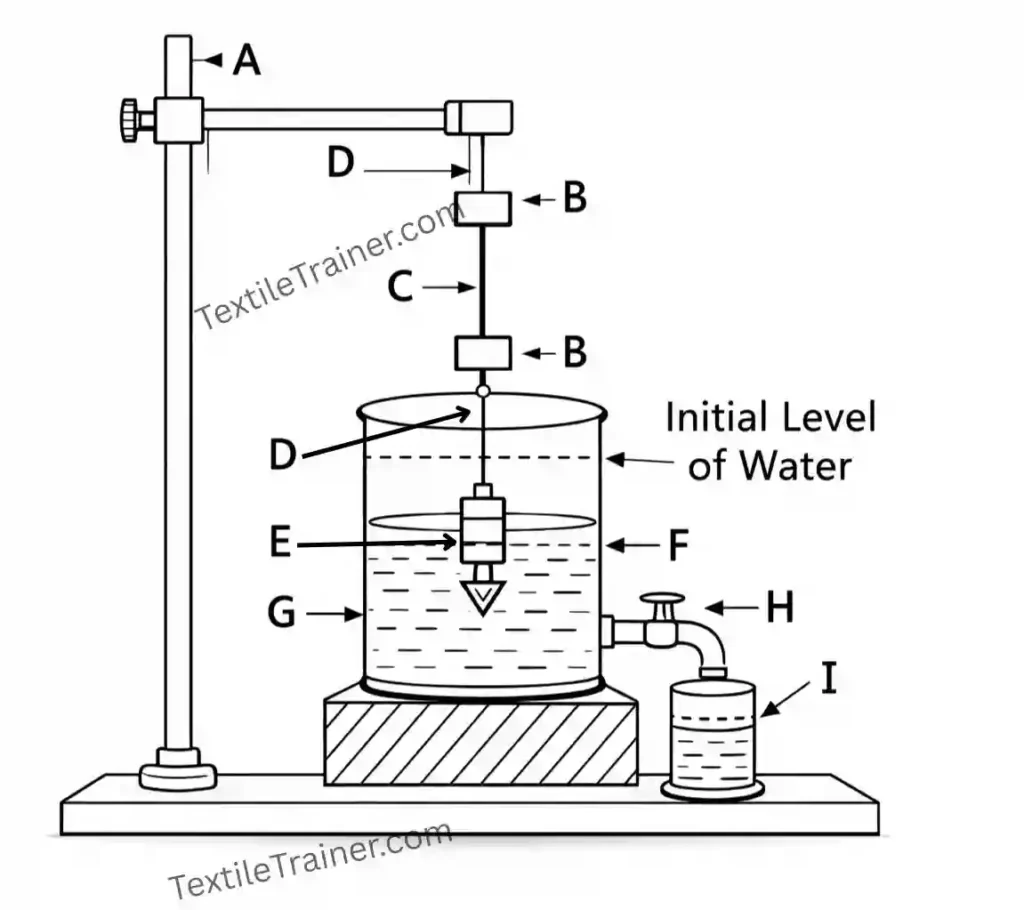
| A= Stand | F= Cylinder jar |
| B= Eyelets | G= Water or calcium chloride solution |
| C= Single fiber | H= Stoper |
| D= Hooks | I= Measuring flask |
| E= Hydrometer or flot |
The schematic diagram of 0′ Neill’s single fibre strength tester is shown in Figure 1. 0′ Neill’s instrument is a hydraulic type which, is an old concept. This apparatus consists of a cylinder or glass jar filled with water. This jar is also fitted with a draining arrangement at the bottom. A vertical float is a main part, and it carries a hook at the top, and this hook engages an eyelet suspended with the mounted fibre. Similarly, another hook will be fixed in an arm above the main vessel from a stand.
The fiber to be tested is mounted between the two eyelets and is suspended from these two hooks. This fibre is first stretched by draining some water and then brought under tension. Again, the tension is increased by draining water, and due to the loading of the float, the fibre breaks or ruptures. Immediately, the valve is closed to stop the drainage of water.
Single fiber strength calculation
The breaking load of the fiber is calculated from the difference between initial and final levels of water in the vessel or by the quantity of water collected in the cup using the following formula:
- Single fiber strength in grams (F)= Vr2 ÷ (R- r2)
- V= the volume of water collected in cc
- R= Dia of the main vessel in inches
- r= Dia of the float in inches
Limitation
O’ Neill’s instrument is very simple, but it has some drawbacks. Hence, this instrument is not used in research and for mill purposes. Here is the limitation of O’ Neill’s instrument:
- The length of the fiber mounted is not specified.
- The method of mounting the fiber is not standardized.
- The quantity of water to be drained initially to stretch the fibers is difficult to determine.
- Any temperature variation will change the quantity of water.
- Water sticks to the glass surface, and hence a lot of corrections have to be applied.
- It is subject to a lot of personal errors.
Conclusion
O’Neill’s single fiber strength tester is very easy to operate. By using this machine, we learnt single fiber strength calculation. But this method is very old. It is not used now owing to some limitations.
Reference
- Wang, L. C. (2008). Physical and mechanical testing of textiles. In Fabric Testing (pp. 90-124). New York: WoodHead Publishing Limited.
- P. Angappan, R. G. (2009). Textile Testing. Tamil Nadu: S.S.M. Institute of Textile Technology.
- Booth, J. (2008). Principles of Textile Testing. New Delhi: BS Publishers & Distributors.
- Saville, B. P. (1999). Physical Testing of Textiles. New York: Woodhead Publishing Limited.
More lab report