Stelometer Test Procedure and Fiber Bundle Strength Calculation
Experiment Name
Study on the Stelometer test procedure and calculate fiber bundle strength/ Study on how to calculate fiber bundle strength by using Stelometer test method.
Introduction
The Stelometer fiber bundle strength tester is a popular instrument for measuring the strength of fiber bundles. Most of the mills or spinning factory uses stelometer for calculating fiber bundle strength. The Stelometer fiber bundle strength tester operates using the pendulum lever principle with a constant rate of fiber loading.
In the case of a bundle of fibers clamped between two jaws, force is proportional to the sine of the angle through which the pendulum moves from a vertical position. A pulling force is applied until the fiber bundle breaks when one jaw remains fixed. On the other hand, the other jaw moves at a controlled speed. The instrument records the maximum force required to break the bundle. This force is known as the breaking strength of the fiber. After the bundle has been broken, the fibers are collected and weighed in mgs. The following formulas are used to calculate fiber tensile strength or tenacity in cN/text.
- Tenacity in cN/tex= { (breaking strength in N × 1.50) ÷ Bundle weight in mg} [ Note: for 1/8 inch gauge length]
- Tenacity in cN/tex= { (breaking strength in N × 1.18) ÷ Bundle weight in mg} [ Note: for 0 gauge length]
Objective
- To know about the principle of the Stelometer.
- Come to learn about the stelometer test procedure.
- To know how to calculate fiber bundle strength by using stelometer.
- To understand the fiber bundle strength behavior.
Apparatus
| Stelometer | Knife |
| Cotton fiber | Comb |
| Pressley clamp | Vise |
| Wrench | Fiber clip |
| Tweezer | Calculator |
Main Parts of Stelometer
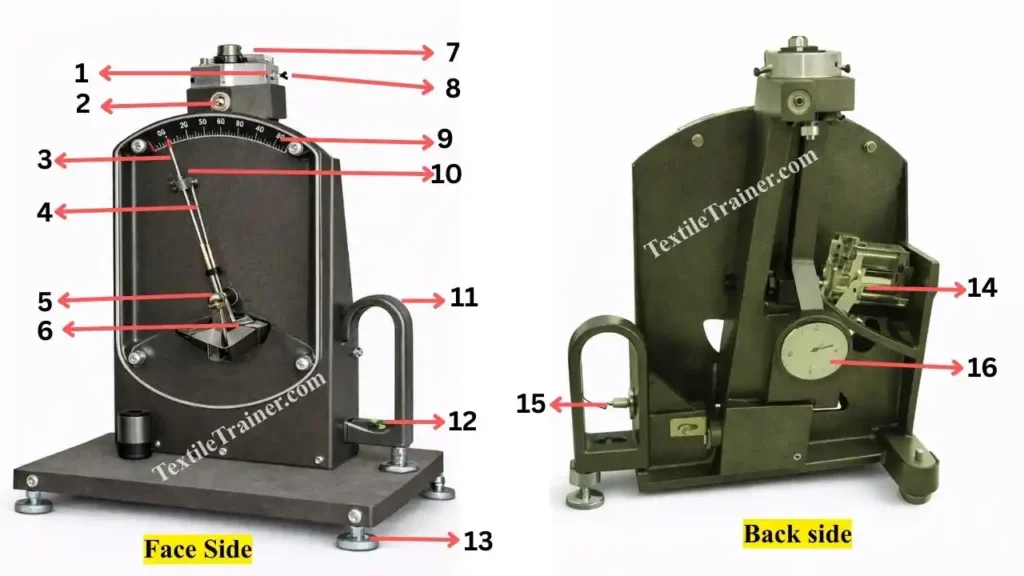
| 1= Clamp base | 9= Force scale |
| 2= Pivot of the pendulum | 10=Elongation scale |
| 3= Force indicator | 11=Handle |
| 4= Elongation indicator | 12= spirit bubble |
| 5= Rotation axis | 13= Leveling screw |
| 6= Dialing pin | 14= Buffer |
| 7= Clamping knob | 15= Trigger |
| 8= Adjusting screw | 16= Pendulum |
Stelometer Test Procedure
Sample preparation
- Initially, a certain amount of fiber from the sample is pulled and bundled.
- To remove trash, short fibers, free fibers, and neps, fiber is combed by a comber.
- Next, grasp the prepared fiber tuft about ¼ of the distance from the end. Now, pull out a portion of the fibers. Next, extracted fibers are held at one end and pulled through the fine comb. This task has to be done two or three times to remove loose fibers, neps, and trash. The other end of the specimen is combed in the same manner.
- After removing fibers from each side, place the specimen in the clamps.
- The vise is first fixed to the table with a long screw, and then the pressley clamp is set in the vise.
- The prepared fiber tuft is then placed in the pressley clamp. Press the clip in the vise and clip the other end.
- Put the bar on the vise and insert the pole into the hole of the clip.
- Afterward, release the bar, and the pole will provide a certain amount of tension for the specimen. Now close the clamp.
- Then, use the wrench screw until the vise rotates to the left.
- In the clamp vise, remove the clamp with fiber bundle, cut off the fibers protruding from the clamp, and insert the clamp into the stelometer.
Testing Procedure
- After inserting the specimen into the clamp base, press the trigger to start the test.
- As a result, the force indicator and then the elongation indicator move until the specimen breaks.
- Make a note of the breaking force and elongation.
- Pressley clamps with broken specimens should be carefully removed from their clamp bases and opened.
- Use the tweezer to weigh all broken fibers on a precision scale with an accuracy of 0.01mg (prepared by the user). Keep a record of the mass of all broken fibers.
Fiber Bundle Strength Calculation
Sample tested at “0” gauge length. Hence, to calculate tensity of the fiber, use the No-2 formula, which ismentioned above.
| Observation | Breaking strength (N) | Bundle weight of fiber (mg) | Tenacity (N/tex) | Average tenacity (N/tex) |
| 1. | 45 | 5 | 10.62 | 10.88 |
| 2. | 42 | 4.5 | 11.01 | |
| 3. | 50 | 5 | 11.80 | |
| 4. | 48 | 5.8 | 9.77 | |
| 5. | 45 | 4.7 | 11.20 |
Conclusion
The stelometer test procedure is a simple and reliable method for measuring fiber bundle strength. It helps to evaluate the quality of cotton fibers before spinning. However, this experiment helps to understand the principle and stelometer test procedure. This will help in our future life as well as carrier life.
Reference
- Booth, J. (2008). Principles of Textile Testing. New Delhi: BS Publishers & Distributors.
- P. Angappan, R. G. (2009). Textile Testing. Tamil Nadu: S.S.M. Institute of Textile Technology.
- Saville, B. P. (1999). Physical Testing of Textiles. New York: Woodhead Publishing Limited.
- Wang, L. C. (2008). Physical and mechanical testing of textiles. In Fabric Testing (pp. 90-124). New York: WoodHead Publishing Limited.
More lab report