Stelometer Fiber Bundle Strength Tester: Explained Step by Step
Introduction
Fiber strength is one of the most important properties. Because it affects yarn quality as well as fabric durability. Before spinning, the fiber bundle strength must be carefully tested. This article is about stelometer fiber bundle strength tester. If one test fiber individually, need considerable amount of time. Moreover, in actual practice, fibers are not used individually. Fiber is used in group form, such as yarns or fabric. Thus, fiber strength should be done in bundle form. The following fiber bundle testers are used in the textile testing sector.
- Pressley Fiber Bundle Strength Tester
- Stelometer Bundle Strength Tester
- Instron Tester
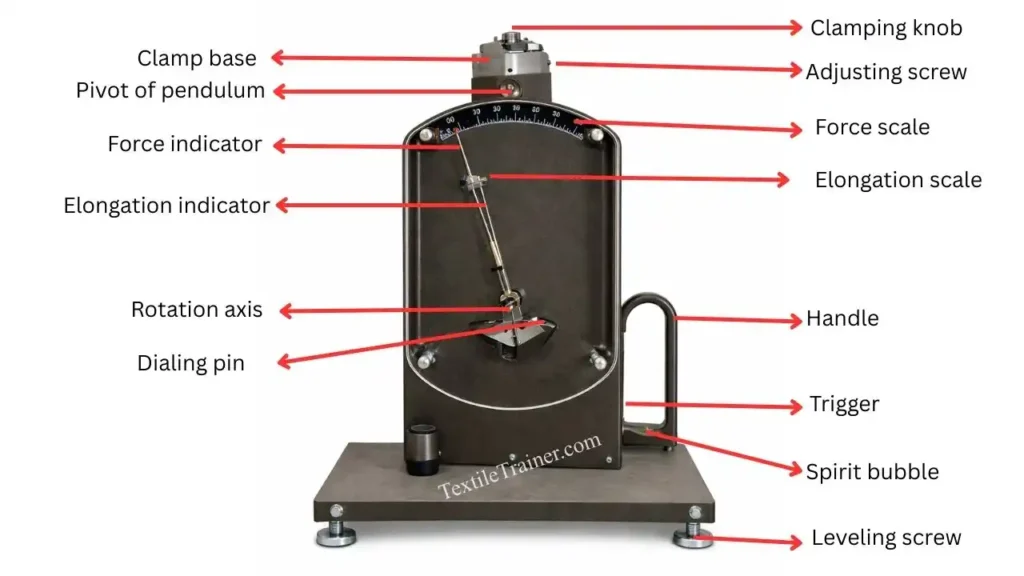
Stelometer fiber bundle strength tester is a popular instrument for the measurement of the bundle strength of fibers. It is used in all mills. Strength and elongation can be measured by the stelometer. Measurement of elongation is possible since the sample is tested at 1/8 inch gauge length.
You may read: Flame Retardant Finishing Recipe for Textile Made Easy
Working Principle of the Stelometer
Stelometer fiber bundle strength tester works on the pendulum lever principle with a constant rate of loading of the fibers. The force acting on the fibers is proportional to the sine of the angle through which the pendulum has moved from the vertical position. A prepared bundle of fibers are clamped between two jaws. One jaw remains fixed, and the other jaw moves at a controlled speed. The machine applies a pulling force until the fiber bundle breaks. The instrument records the maximum force required to break the bundle. This force is called the breaking strength of the fiber. After the bundle has been broken the fibers are collected and weighed in mgs. Now, the tensile strength of fiber or tenacity in cN/tex can calculated by using the follow formulas.
- Tenacity in cN/tex= { (breaking strength in N × 1.50) ÷ Bundle weight in mg} [ Note: for 1/8 inch gauge length]
- Tenacity in cN/tex= { (breaking strength in N × 1.18) ÷ Bundle weight in mg} [ Note: for 0 gauge length]
N.B.: In formula no. 1, 1.50 is used in the formula, since the length of the sample is 1.50 mm at 1/8 inch gauge length test. In the formula no. 2, 1.18 is used in the formula, because the sample length at 0 gauge length is equal to 1.18 mm.
Machine Description
Stelometer fiber bundle strength tester works on a pendulum beam principle. It measures the tensile properties of a fiber bundle by applying a controlled load until the fibers breaks. The following the description of main parts and their functions
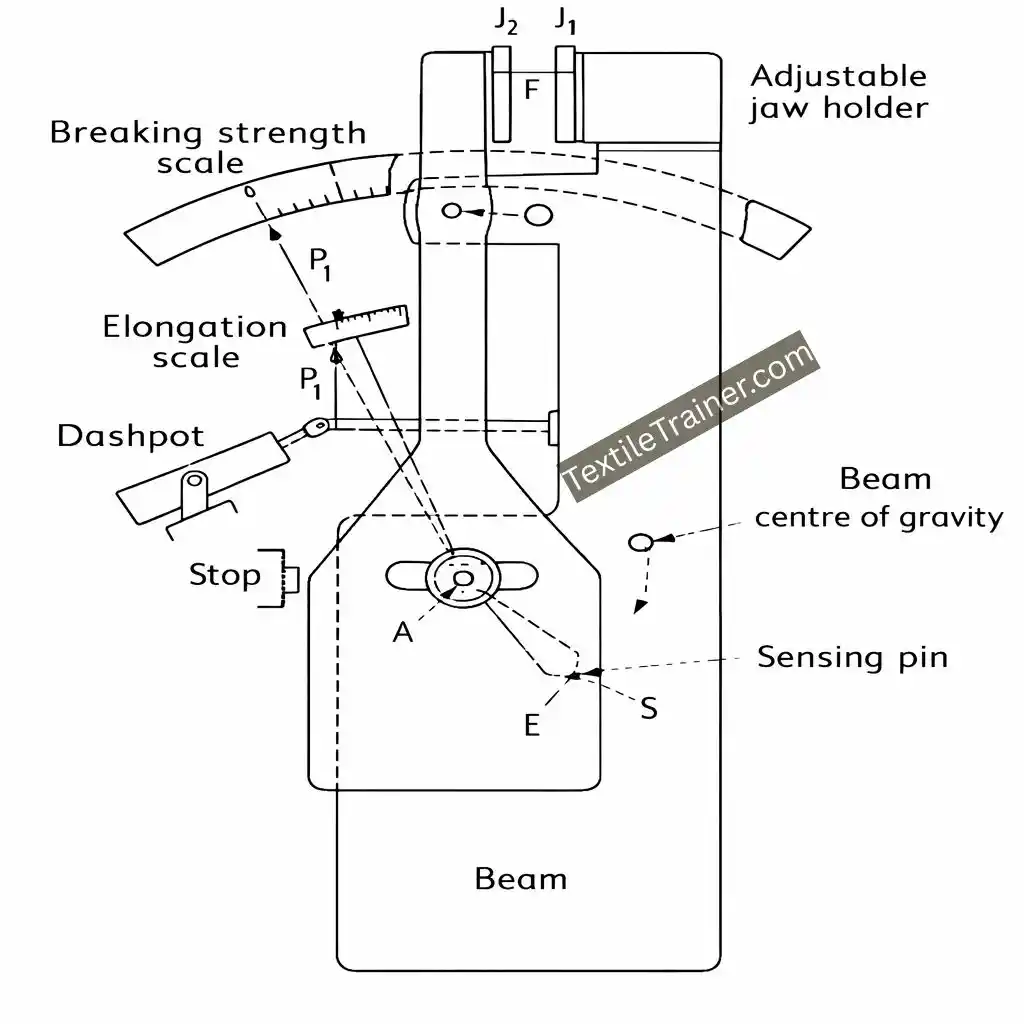
- Adjustable jaw holder (J1 and J2): Two jaws are used to grip the fiber bundle. The distance between the jaws is fixed according to standard gauge length. One jaw remains fixed, and the other moves during loading.
- Beam (Pendulum Arm): The beam pivots around a central axis (A). When force is applied to the specimen, the beam deflects. The movement of the beam is proportional to the applied load.
- Breaking strength scale: This scale directly indicates the maximum force applied at the moment of fiber rupture. The pointer (P1) moves along the calibrated arc.
- Elongation scale: The elongation scale measures the extension of the fiber bundle before breaking.
- Dashpot: Dashpot controls the sudden movement of the beam. It ensures smooth motion and prevents vibration. It also helps to give accurate readings.
- Sensing pin (S): It detects the movement of the beam. It also transfers the mechanical motion to the scale pointer system.
- Stop mechanism: It limits excessive movement and protects the instrument from damage after specimen breakage.
- Centre of gravity adjustment: It ensures proper balancing of the beam for accurate load measurement.
You may read: Lotus fiber manufacturing process explained simply with 9 Steps
Specimen Preparation
Specimen preparation of the stelometer fiber bundle strength tester involves two steps. One is fiber preparation, and the other is sample installation.
Fiber preparation
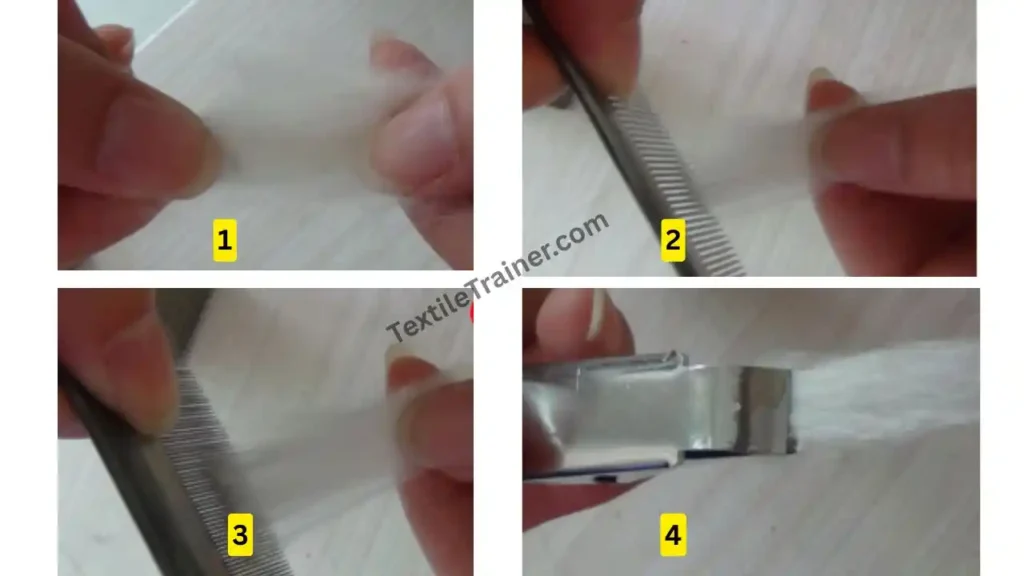
- Initially, a certain amount of fiber from the sample is drawn and tidy it to bundle by the pull method.
- Now, fiber is combed by a comber to remove trash, short fiber, free fibers, and neps.
- Subsequently, grasp the prepared fiber tuft about ¼ of the distance from the end. Now, pull out a portion of the fibers. Next, extracted fibers are held by one end and pulled through the fine comb. This task has to be done two or three times to remove loose fibers, neps, as well as trash. The other end of the specimen is combed in the same manner.
- Then, remove fibers from either side to obtain the correct mass. Now, the specimen is ready to be placed in the clamps.
Sample installation
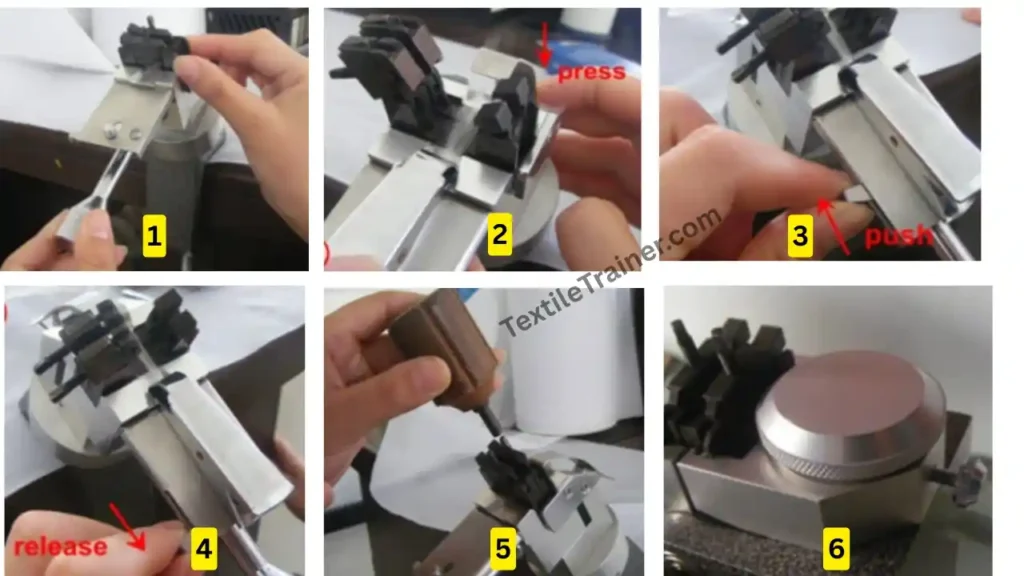
- Initially, vise is fixed to the table with a long screw and set the pressley clamp is set in the vise.
- Now, the prepared fiber tuft is put in the pressley clamp. Press the clip which fixed on the vise and clip the other end of the fiber.
- Push the bar on vise and let pole in the hole of clip.
- Next, release the bar, the pole will provide a certain pretension for specimen. Now, close the clamp.
- Then, use the wrench screw done the clamp till the vise rotates to left.
- Take the pressely clamp with fibe bundle out of the clamp vise, cut the fibers protruding the pressely clamp off, and put the pressely clamp into the stelometer.
Testing Procedure
- To start the test, press the trigger after putting the press clamp with specimen into the clamp base.
- Force indicator and then elongation indicator move until specimen breaks.
- Take note of the breaking force and elongation.
- Pressley clamps with broken specimens should be taken out of the clamp base and opened carefully.
- By using the tweezer, weigh all broken fibers on a 10mg precision scale with an accuracy of 0.01mg (prepared by the user). Make a record of the mass of all fibers.
Calculation
Now, the tensile strength of fiber or tenacity in cN/tex can be calculated by using the follow formulas.
- Tenacity in cN/tex= { (breaking strength in N × 1.50) ÷ Bundle weight in mg} [ Note: for 1/8 inch gauge length]
- Tenacity in cN/tex= { (breaking strength in N × 1.18) ÷ Bundle weight in mg} [ Note: for 0 gauge length]
Lets,
- Breaking strength in N at “0” gauge length= 45 N
- Bundle weight in mg= 5 mg
| Observation | Breaking strength (N) | Bundle weight of fiber (mg) | Tenacity (N/tex) | Average tenacity (N/tex) |
| 1. | 45 | 5 | 10.62 | 10.82 |
| 2. | 42 | 4.5 | 11.01 |
Advantages of the Stelometer
- The stelometer fiber bundle strength test is simple and quick.
- It requires less time compared to single fiber testing.
- This method is suitable for routine cotton testing in spinning mills and research laboratories.
- It provides an accurate result if the sample is prepared properly.
Limitation of the stelometer
- The test does not measure individual fiber strength.
- The test result depends on proper fiber alignment.
- Variation in bundle thickness can affect the accuracy.
- It is not suitable for very long filament fibers.
You may read:Button Pull Testing for Garment Safety explained in a Simple Way
Conclusion
The stelometer fiber bundle strength tester is used mainly for cotton testing. It works on a tensile testing principle and measures the breaking force of a fiber bundle. The stelometer fiber bundle strength testing method is simple and reliable. If you have any questions about the fiber bundle strength tester, feel free to ask me.
Reference
- Booth, J. (2008). Principles of Textile Testing. New Delhi: BS Publishers & Distributors.
- P. Angappan, R. G. (2009). Textile Testing. Tamil Nadu: S.S.M. Institute of Textile Technology.
- Saville, B. P. (1999). Physical Testing of Textiles. New York: Woodhead Publishing Limited.
- Wang, L. C. (2008). Physical and mechanical testing of textiles. In Fabric Testing (pp. 90-124). New York: WoodHead Publishing Limited.
- User Manufal for Model YG011 Fiber Bundle Strength Tester by FYI