Colorfastness to Perspiration Test Method Explained AATCC TM15
Introduction
AATCC TM15 colorfastness to perspiration test method determines the fastness of colored fabric to the effects of acid perspiration. This testing method is suitable for dyed, printed fibers, yarns, and fabrics. Colorfastness is the resistance of a textile material to change in color or to transfer of its color to adjacent materials. Textile products, especially fabric, often come into contact with human sweat during daily work. This sweat can affect the color of the fabric. It may cause staining on adjacent material. Therefore, colorfastness to perspiration test is a crucial test for quality control of textile products. ISO 105 E04:2013 is a popular testing method for the colorfastness to perspiration test. But the AATCC TM 15 perspiration test method is also used. This article will expose the AATCC TM 15 perspiration test method.
Principle of AATCC TM 15 Perspiration Test
A dyed textile specimen is kept in contact with another fabric to check color transfer. Then the specimen is soaked in an artificial acidic perspiration solution. After that, a fixed pressure is applied, and the specimen is dried slowly. After drying, the test fabric is checked for color change and the adjacent fabric for color staining.
Apparatus
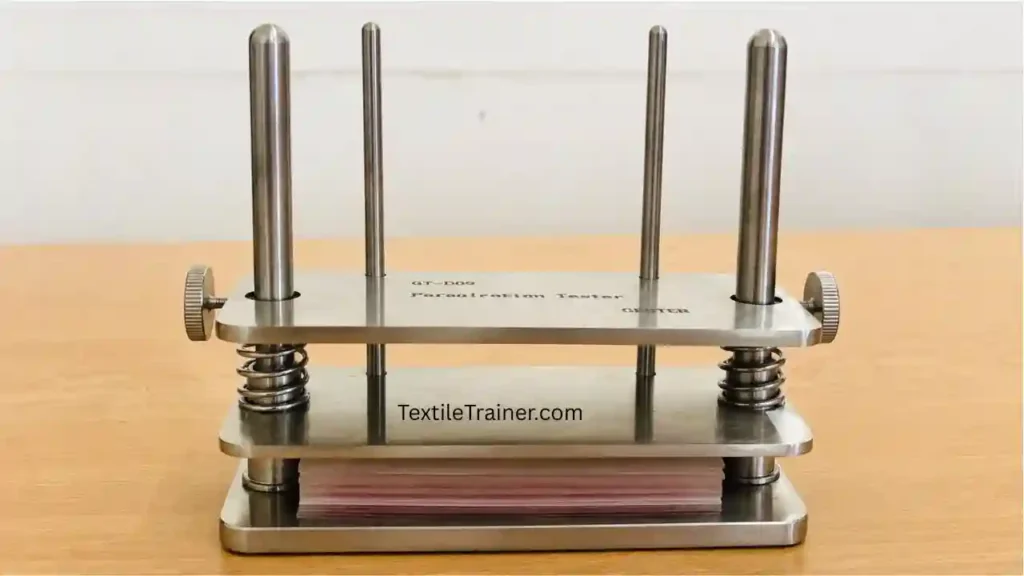
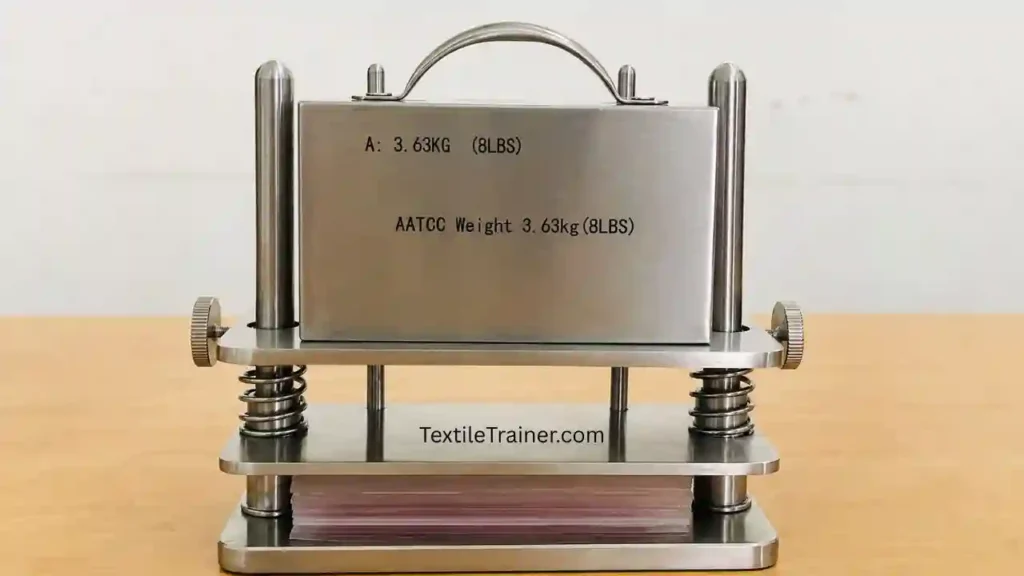
- Perspiration tester
- Acrylic plate (60mm×115mm×1.5mm)
- Weight piece 3.6 kg
- Oven
- pH meter or pH paper
- Petri dish (9cm dia, 2 cm deep)
- Grey scale for assessing color change and staining (AATCC gray scale)
- Cold-cut multifiber test fabric (8mm band) containing acetate, cotton, nylon, silk, viscose rayon, and wool shall be used for specimens containing silk. Multifiber test fabric (8mm brand) containing acetate, cotton, nylon, polyester, acrylic, and wool shall be used with specimens with no silk present.
- Wringer
- White AATCC Textile blotting paper
- Acid perspiration solution.
- Undyed adjacent fabric.
Recipe for Perspiration Test
| Chemicals | Amount |
| Sodium Chloride (NaCl) | 10± 0.01 gm |
| Lactic acid, USP 85% | 1± 0.01 gm |
| sodium phosphate, dibasic, anhydrous (Na2 HPO4 ) | 1± 0.01 gm |
| L-histidine monohydrochloride (C6 H9 N3 O2 ⋅HCl⋅H2 O) | 0.25± 0.01 gm |
| pH | 4.3± 0.2 |
Working Procedure
Sample Preparation
- At first, the fabric is cut into 6×6± 0.2 cm
- Now, the multifiber test fabric is cut into 5×5± 0.2 cm
- Subsequently, fabric and multifiber are sewn together by a single seam stitch along one edge of the fabric.
- For yarn or loose fiber test: the multifiber test fabric is cut into 5×5± 0.2 cm. Now, the undyed fabric is cut into 6×6± 0.2 cm. Then, weighted the both fabrics (multifiber+ undyed fabric). The next step, take a mass of yarn or loose fiber approximately equal to one half of the combined mass (multifiber+ undyed fabric). Subsequently, weighted yarn or loose fiber are kept between the multifiber and undyed fabric. Finally, the composite (multifiber+ yarn/loose fiber + Undyed fabric) are sewn along all four sides.
- N.B: Multifiber test fabric should not be fused, sealed, or have pre-sewn edges. This might have thickness variations at the edges. Hence, it would cause uneven compression during testing.
Acidic Solution Preparation
- Initially, 500 ml of distilled water is taken into a volumetric flask.
- Now, all chemicals (according to the mentioned recipe) are dissolved in 500 ml of water.
- Then, the volumetric flask is filled with 500 mL of distilled water to make 1000 ml solution.
- Subsequently, check the pH of the solution. If it is not 4.3± 0.2, discard the solution and make the solution again. Make sure the ingredients are weighed accurately.
- N.B: Prepared solution should be used within three days. After three days, the solution should be discarded.
Testing Procedure of Perspiration Test
- The specimen is placed in a Petri dish and added to the acidic perspiration test solution to a depth of about 1.5 cm.
- Now, the specimen is soaked in the acidic solution for 30±2 minutes to ensure complete wetting.
- If the specimen is hard to wet, then it passes through the wringer until the acidic perspiration test solution completely penetrates it.
- After 30±2 minutes, the test specimen passes through the wringer. Specimen should be wet picked up 2.25±0.05 times its original weight. But some fabrics cannot retain this amount of solution. In that case, AATCC Textile Blotting Paper should be used to retain the solution.
- Now, specimen assembly on the acrylic plates. Position the multifiber strips perpendicular to the length of the plate. With 21 acrylic plates, 20 specimens can be tested. If the number of test specimen below 20, but you have to use 21 acrylic plates.
- After placing the 21 plates, set the dual plates with compensating springs in position, place 3.63 kg(8.0 Ib) on top, making a total of 4.54 kg (10.0 Ib) under the pressure plate.
- Then, lock the pressure plate by turning the screws. Now, remove the weight from the top of the specimen.
- Subsequently, kept the perspiration tester with the specimen in the oven and main 38±10 C for 6 hours.
- After 6 hours, the perspiration tester was unloaded from the oven, and the multifiber and test fabric were separated. Now, keep the multifiber and test fabric in a conditioned atmosphere overnight.
- Then, the test fabric is evaluated using a color-changing gray scale, and the multifiber test fabric is checked by color staining gray scale.
Result
| Description of test | Result |
| Color change in shade | 3-4 |
| Color staining to acetate | 4 |
| Color staining to cotton | 4 |
| Color staining to nylon | 3-4 |
| Color staining to polyester | 3 |
| Color staining to acrylic | 4 |
| Color staining to wool | 3 |
Conclusion
The color fastness to perspiration test (AATCC TM15) is a crucial textile testing method. It is used to determine the color resistance of fabric to sweat. This test measures both color change and color staining of dyed fabric. Though AATCC TM 15 is not popular among buyers. ISO 105 E04 is a popular method for the perspiration test.