Rainwater Fabric Dyeing: Water Source for Textile Industry
Introduction
Rainwater may be an alternative source of water for the textile industry. This article will describe the rainwater fabric dyeing process. This article will compare rainwater fabric dyeing shade and groundwater fabric dyeing shade. Water is one of the crucial resources for the textile industry, especially for wet processes. Water is used for desizing, scouring, bleaching, dyeing, printing, washing, and finishing of fabric or textile materials. Additionally, textile factories depend heavily on groundwater. But groundwater levels are decreasing day by day. So, it is high time to search for an alternative water source for the textile industry, especially for fabric dyeing factories. Hence, this article will try cotton fabric dyeing with rainwater and compare the dyeing shade with a groundwater-dyed sample.
Why use rainwater as an alternative water source for Textile Dyeing?
A recent FAO report on sectoral water use indicates that Bangladesh’s total annual freshwater withdrawal in 2014 was 35.87 billion cubic meters, and industrial water use made up only 2.147% of total water use, while agriculture makes up 87.82% of Bangladesh’s water use, followed by domestic water at 10.4%. By 2030, it is estimated that industrial water demand will increase by 109%, domestic water demand will increase by 75%, and agricultural water demand will increase by 43% . For one kilogram of cotton fabric to be dyed, 110 liters of water are needed, so an average textile mill with a capacity of 8 tons per day consumes 1.6 million liters of water each day. So, it is a huge amount.
Besides, the level of groundwater is decreasing day by day. One day, the textile industry will face a scarcity of water. So, it is crucial to search for an alternative water source instead of groundwater. Hence, rainwater is selected as an alternative source of dyeing water. Rainwater may be an alternative source of water instead of groundwater. However, rainwater fabric dyeing has some limitations. Limitations of rainwater fabric dyeing will be discussed at the end of the article.
Rainwater Fabric Dyeing Process
This study used cotton knit fabric. Cotton knit fabric is dried using the same dyeing recipe and dyeing curve. Reactive dye is used as dyestuff. One cotton knit fabric will be dyed with rainwater, and the other will be dyed using groundwater. The rainwater fabric dyeing process is divided into 5 sections. The following are the sections of the fabric dyeing process
- Typical recipe for rainwater fabric dyeing
- Dyeing recipe calculation
- Fabric dyeing curve
- Working procedure
- Aftertreatment
1. Typical Recipe for Rainwater Fabric Dyeing Process
| Chemical | Amount (gm/L) |
| Wetting agent | 0.5 gm/L |
| Sequestering agent | 2.0 gm/L |
| Anti-foaming agent | 1.0 gm/L |
| Leveling agent | 1.0 gm/L |
| Dyes (reactive) | 1% |
| Glauber salt | 30 gm/L (for 1% shade) |
| Soda ash | 10 gm/L (for 1% shade) |
| Temperature | 60±50 C |
| Time | 60 min |
| pH | 10.5±0.5 |
| M:L | 1:30 |
| Sample weight | 5 gm |
2. Dyeing Recipe Calculation
The following are the two formulas for dyeing recipe calculation
- Required auxiliary= (Total amount of liquor× recipe amount) ÷ (1000× stock solution)
- Required dyestuff= (Fabric weight × Shade percentage) ÷ Stock solution
Now, Let’s calculate the dyeing recipe according to the above-mentioned recipe for vat dye
- Total amount of liquor required for vat dyeing= 5×30= 150 ml
- Wetting agent required= {total amount of liquor× recipe amount (gm/l)} ÷ (1000×stock solution) = (150×0.5) ÷ (1000× 1%) = 7.5 ml [ use 1 % stock solution]
- Sequestering agent required= (150×2) ÷ (1000× 1%) = 30 ml [ use 1% stock solution]
- Anti-foaming agent required= (150×1) ÷ (1000× 1%) = 15 ml [ use 1% stock solution]
- Required leveling agent= (150×1) ÷ (1000× 1%) = 15 ml [ use 1% stock solution]
- Require salt= (150×30) ÷ 1000 = 4.5 gm [ No need stock solution as we will take it solid form]
- Required soda ash = (150×10) ÷ 1000 = 1.5 gm [ No need stock solution as we will take it solid form]
- Required dyestuff= (5× 1%)÷ 1%= 5 ml [ use 1% stock solution]
- Required water= {150- (7.5+30+15+15+5)}= 77.5 ml
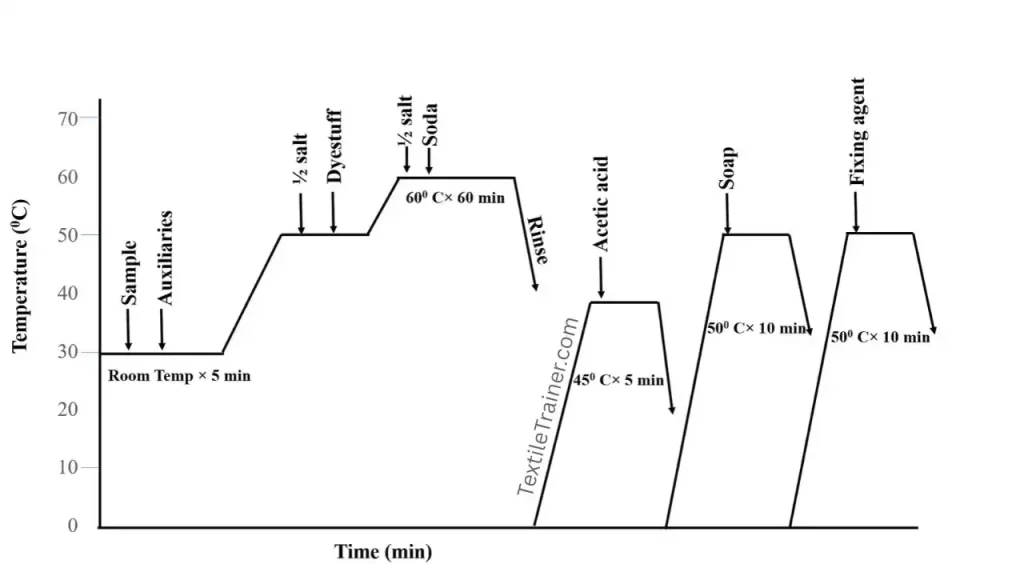
1. Fabric Dyeing Curve
2. Working procedure
- At first, we prepare a stock solution for each type of sample using rainwater and groundwater.
- Then add the required amount of auxiliaries according to the dyeing recipe calculation in the dyeing pot at room temperature without soda ash. Now, check the pH of the solution using pH paper. The optimum pH is 10.5±0.5 for reactive dye, and load the dyeing pot into the infrared laboratory dyeing machine.
- The next step, raise the temperature in 500 Cand add dyestuff and salt (1st dosing i.e., half salt). Raise the temperature at 600 C. After raising the temperature to 600 C, add soda and salt (2nd dosing).
- Now, run the dye bath for 60 min for complete dyeing.
- Then drain the dye bath and carry on the aftertreatment process.
5. After-treatment
- At first, samples are treated with acetic acid (1ml/L) to neutralize the alkali for 5 min in the after-treatment process.
- Then, samples are treated with soap (1 gm/L) for 10 min to remove unfixed dyestuff from the fabric surface.
- After that, samples are treated with a fixing agent (1 gm/L) for 10 min to fix the dye molecules to the fabric.
- Finally, rinse the sample and dry in an oven.
Test Report
Rainwater Vs groundwater dyed sample
Colorfastness to rubbing
Color fastness to rubbing is carried out according the testing method of ISO 105-X12:2016
| Sample | Dry rubbing | Wet rubbing |
| Rainwater dyed sample | 4-5 | 4 |
| Groundwater dyed sample | 5 | 4-5 |
Colorfastness to perspiration
Color fastness to perspiration is carried out according the method of ISO-105-E04
| Sample | Medium | Color change | Color staining | |||||
| Di-acetate | Bleached cotton | Poly-amide | Polyester | Acrylic | Wool | |||
| Rainwater-dyed sample | Acid | 4-5 | 4-5 | 3-4 | 4 | 4 | 4 | 4 |
| Alkaline | 4-5 | 4-5 | 3-4 | 4 | 4 | 4 | 4 | |
| Groundwater dyed sample | Acid | 5 | 4-5 | 4 | 4 | 4 | 4 | |
| alkaline | 5 | 4-5 | 4 | 4 | 4 | 4 | 4 | |
Colorfastness to Washing
Color fastness to wash of dyed all samples was tested according to ISO-105:CO6
| Sample | Color change | Color staining | |||||
| Di-acetate | Bleached cotton | Poly-amide | Polyester | Acrylic | Wool | ||
| Rainwater-dyed sample | 4 | 4-5 | 3 | 4 | 4-5 | 4 | 4-5 |
| Groundwater-dyed sample | 5 | 4-5 | 4 | 4 | 4-5 | 4 | 4-5 |
Colorfastness to light
Colorfastness to light is carried out according method of ISO-105-BO2(method-3).
| Sample | Rating |
| Rainwater-dyed sample | 3.0 |
| Groundwater-dyed sample | 3.5 |
SEM test
Final Result and Discussion
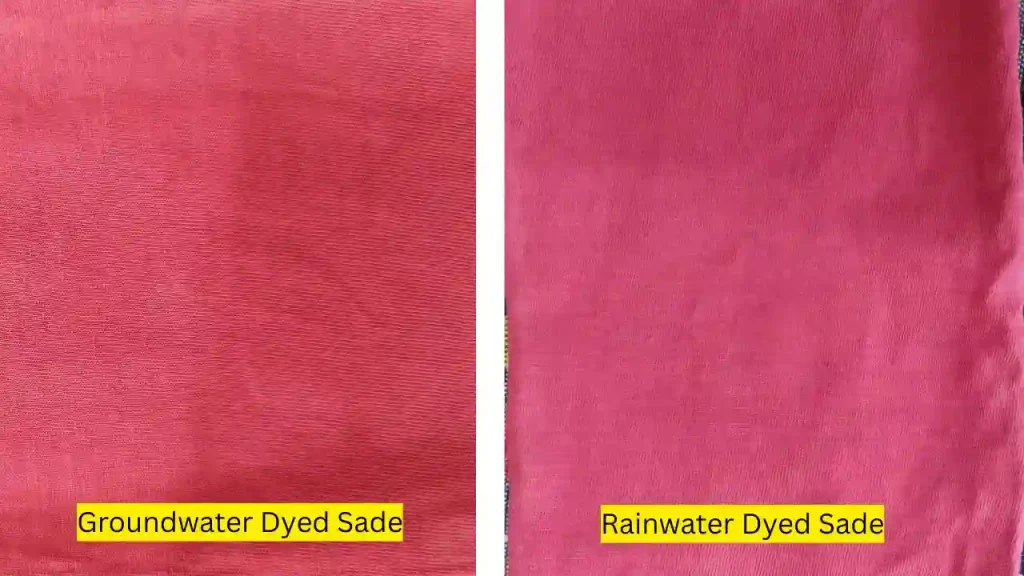
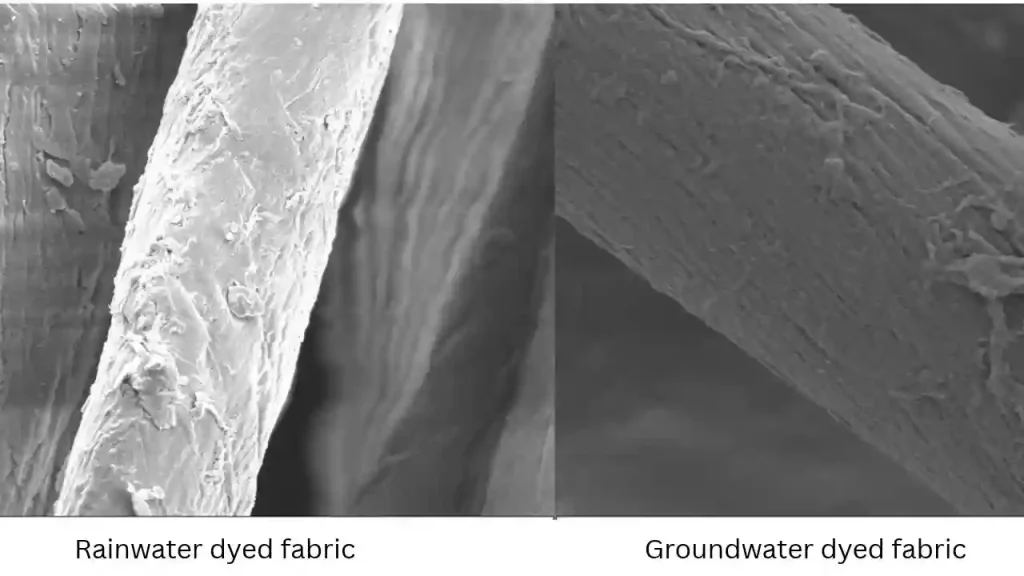
This study aims to discover an alternative source of water for the textile industry. Usually, textile industries use groundwater for textile material processing. But this study uses rainwater for cotton fabric dyeing instead of groundwater. Finally, we found that both rainwater dyeing shade and groundwater dyeing shade are almost the same. But, we found uneven dyeing shade in the case of rainwater dyed shade. The different mineral compounds present in rainwater may impact the dyeing shade. Colorfastness tests are slightly changed. But it is negligible. In the SEM test, the surface of the knit fabric is smooth in the case of the groundwater-dyed sample, while the surface of the rainwater-dyed sample is rough. As there are many mineral salts are present in the rainwater. Finally, we conclude that rainwater may be an alternative water source for the textile industry. But there are some limitations of the rainwater fabric dyeing process:
- Rainfall is not continuous. Hence, it is difficult to collect enough rainwater to meet the needs of the entire year.
- Additionally, rainwater quality can change. For example, roof contamination, airborne particles, and storage conditions can influence water quality.
- Filtration, disinfection, pH adjustment, or other treatment may be required.
- Finally, it is difficult to get the same shade all the time. Because water quality can affect the shade matching.
Conclusion
Rainwater fabric dyeing provides a possible alternative to groundwater for the textile industry. But it has some limitations. So, further research is required to solve the limitations in an effective way. Rainwater fabric dyeing process is not a universal replacement for the groundwater dyeing process. However, if you have questions about the rainwater fabric dyeing process, feel free to ask me.
Reference
- Surid, S. M., Solaiman, M., Patwary, A. S., Rahman, H., Sinha, P., & Hossain, B. (2019). Dyeing of cotton fabric with ground water and sea water: comparison of their fastness properties. Journal of Textile Engineering & Fashion Technology, 5(6). https://doi.org/10.15406/jteft.2019.05.00213
- Initiative, 1–57. https://www.siwi.org/wp-content/uploads/2017/06/Water-Governance-Mapping-Report-Ethiopia.pdf
- A.B.M. Foisal, M. Shohel R. (2017). Dyeing of cotton fabric with used water and rainwater. SEU Journal of Science and Engineering, 11.