Shedding Tappet Construction for Twill weave
Introduction
This article is about shedding tappet construction in twill-weave fabric. Twill weave fabric is one of the most common fabric structures. Twill fabric is known for its diagonal pattern. Proper shedding is required to produce a twill design on fabric. Tappet shedding is often used for simple twill fabrics. SO, it is crucial for textile engineering shedding tappet construction process. Don’t worry, this is your proper solution. Here, shedding tappet construction will show a simple way.
Core Tappet Construction Terms
To design or shedding tappet construction, the following points and dimensions must be taken into consideration:
- Pattern to be produced in the fabric, that is, the number of picks in a repeat of the design and the lifting order.
- Lift or stroke of tappet.
- Distance from the centre of the driving shaft to the nearest point of contact with the treadle bowl.
- Time during which the healds will remain stationary, that is, the dwell of the tappet.
- Diameter of the treadle bowl.
1. Lift of Tappet
To find out the required lift of a tappet, the number of picks to a repeat of the design and the order of lifting the heals must be obtained first. Secondly, it is necessary to ascertain the depth of the shuttle to be used, when measured along its front edge. Thirdly, other points to be measured are, (a) the distance of the front edge of the shuttle from the last pick of weft in the fabric when the shuttle enters the shed, and (b) the distance from the last picks to the healds shaft. Lastly, the depth of the shed should only be sufficient to allow the shuttle to pass; therefore, the “lift’ or “stroke of the heald “ is dependent upon the depth of the shuttle used. The shed, when opened, should remain open only long enough to allow the shuttle to pass through.
2. Lift of Tappet for Back Heald
As the back heald is required to give a greater lift than the front heald to obtain a uniform depth of shed, the tappet operating the back heald must be constructed to give a greater lift.
3. Distance from Tappet Shaft to Treadle Bowl
The distance from the centre of the tappet shaft to the smallest part of the tappet surface varies according to its position in the loom and the number of picks in one repeat. This distance for plain weave tappets placed under the healds is 1 ¼” or 3.175 cm or a little more. Tappet for 3,4 or 5 picks to the round, similarly placed, vary from 2 to 2 ½ “ or 5.08 to 6.35 cm. if placed at the loom end for 3,4 or 5 picks, they vary from 2 ½ “ to 3” or 6.35 to 7.62 cm. Above 5 Picks to the round, tappets are increased considerably in size. A wood croft tappet for 3 to 16 picks has 17” or 43.18 cm in diameter, and larger still for higher picks.
4. Dwell of Tappet
The tappet should be so made that heals will remain stationary while the shuttle passes through the shed. This stationary period is know as “pause” or “dwell of healds”, but the duration must vary to suit the fabric to be made. The length of dwell of the shedding tappet or how long the shed will remain open, will be regulated, partly as the warp threads require to be spread and partly according to the width of a loom.
Shedding Tappet Construction
For shedding tappet construction for twill fabric, draw a tappet for a 1 down, 1 up, 1 down, 1 up, and 2 down (six picks to the round) twill, with the following particulars:
- Centre of the tappet shaft to the nearest point of contact with the treadle bowl, 4” or 10.16 cm.
- Lift of tappet, 2” or 5.08 cm.
- Treadle bowl, 1 1/2 “ or 3.81 cm diameter.
- Finally, Dwell, one-third of a pick.
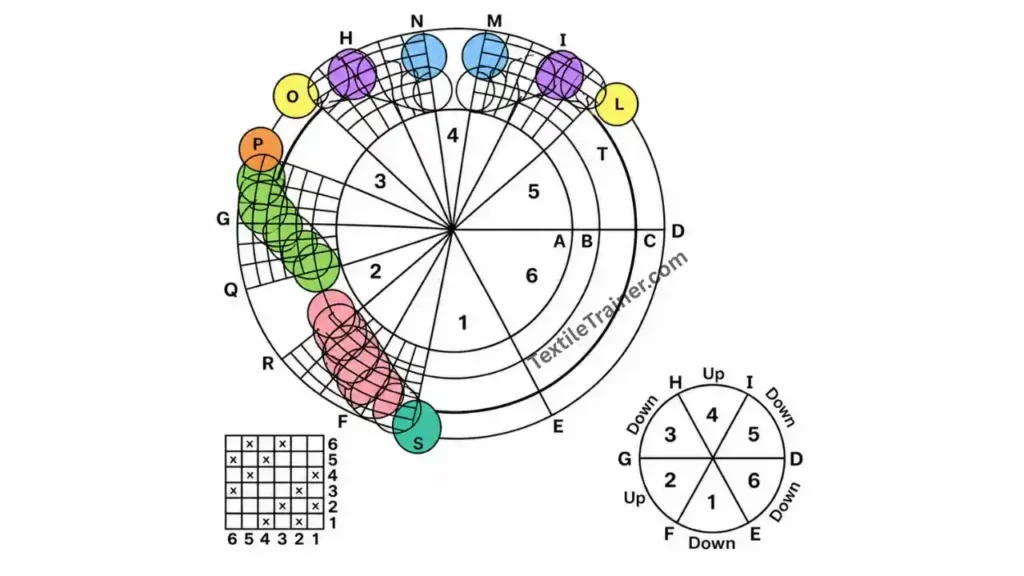
The method adopted for the construction of a six-shaft twill tappet is shown in figure 1
- Initially, to shedding tappet construction for twill fabric, draw a radius of 4” or 10.16 cm, 4 ¾ “ or 12.065 cm, and 6 ¾ “ or 17.145 cm, describe the circule A, B, and C respectively.
- As there are six picks to the round, divide the circles into six equal parts by the lines, D, E, F, G, H, I.
- Then, as there is one third of a pick dwell, divide each pick into three equal pars and take the middle one for dwell.
- The next step, rule the ones L, M, N, O, P, Q, R, S to the centre, and divide the spaces allowed for change of heald into six equal parts, and the distance between the circles B and C into six unequal parts, as previously done.
- Subsequently, from the corners of the unequal spaces describe the circles representing the movement of the treadle bowl, and obtain the shape of the tappet accordingly.
- Finally, it will be noticed that at the point L, the treadle bowl begins to dwell and remains stationary until it reaches the point S, when it begins to go up. The heald will, thus, be down for the first, up for the second, and down for the third pick, up for the fourth, and down for the fifth and sixth picks.
Eccentric Movement
At a radius of half the lift of tappet, that is, 1” or 2.54 cm, a semi-circle T is described between the circles B and C. Its circumference is divided into six equal parts and six perpendicular lines are drawn from them. Thus the lift of tappet is divided into six unequal parts, to obtain the desired eccentric shape of the tappet to give the variable movement to the heald.
Twill Tappet Outlines
A few designs with picks to the round and the shape of the tappets are shown below:
Three shaft twill
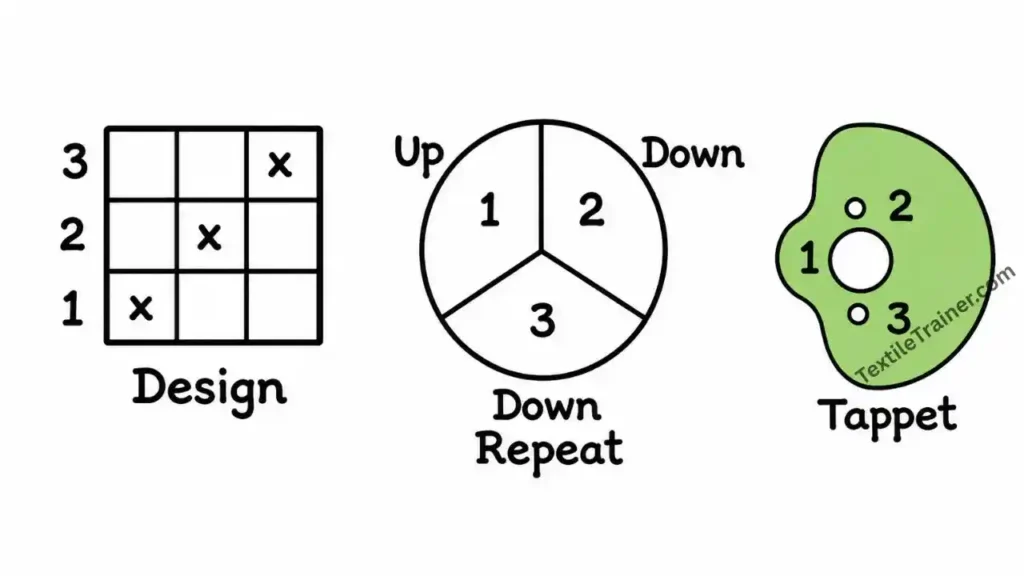
The design one up two down, the repeat and picks to the round, and the outline of this twill tappet are shown in figure 2.
Four-shaft twill
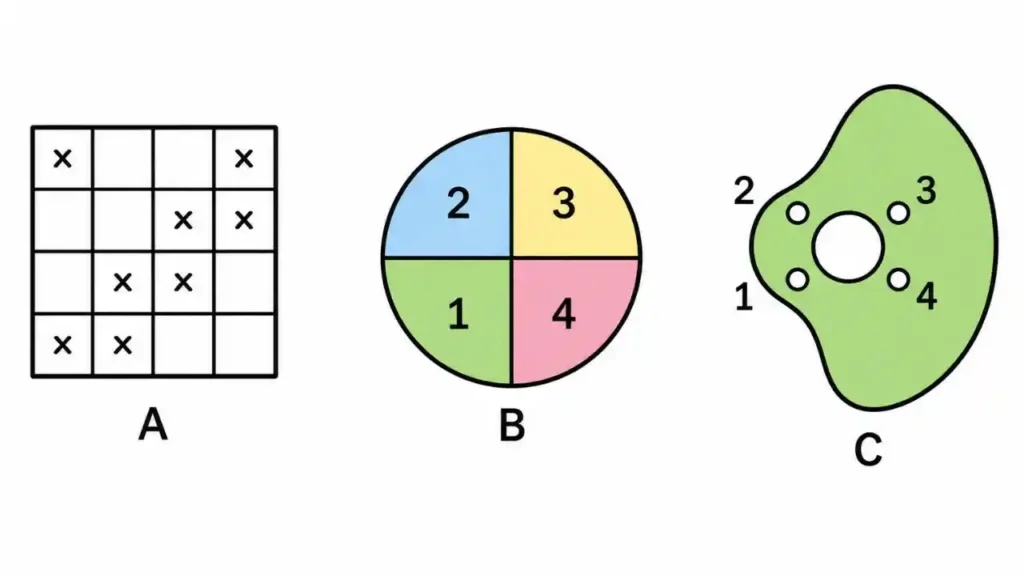
The design 2 up 2 down, the repeat and picks to the round, and the outline of this four-shaft twill tappet are shown figure 3.
Five shaft twill and satin
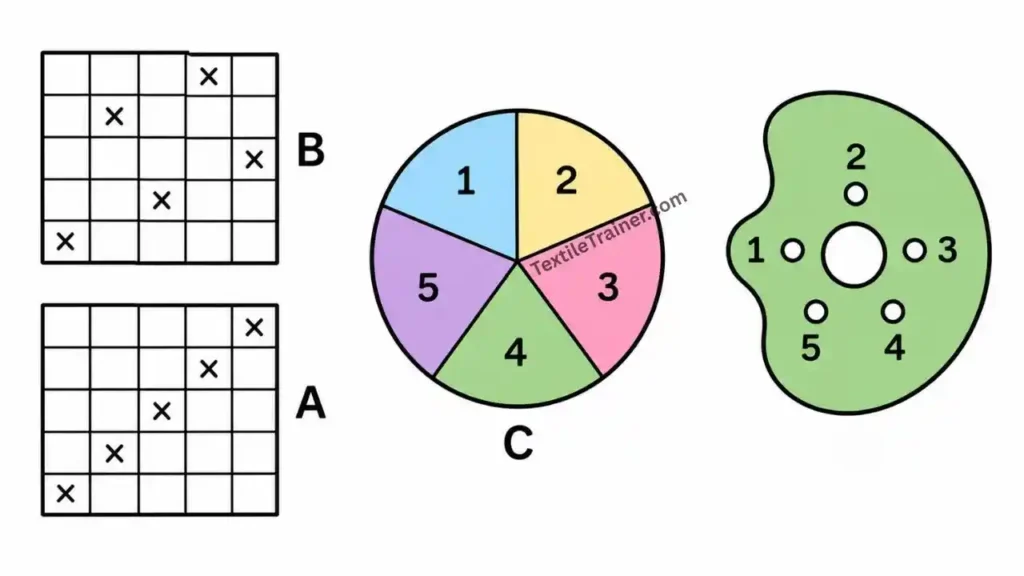
Two designs for dive-shaft twill and stain, the repeat and picks to the round, and the outline of the tappet are shown in the figure 4
Eight-shaft twill and stain
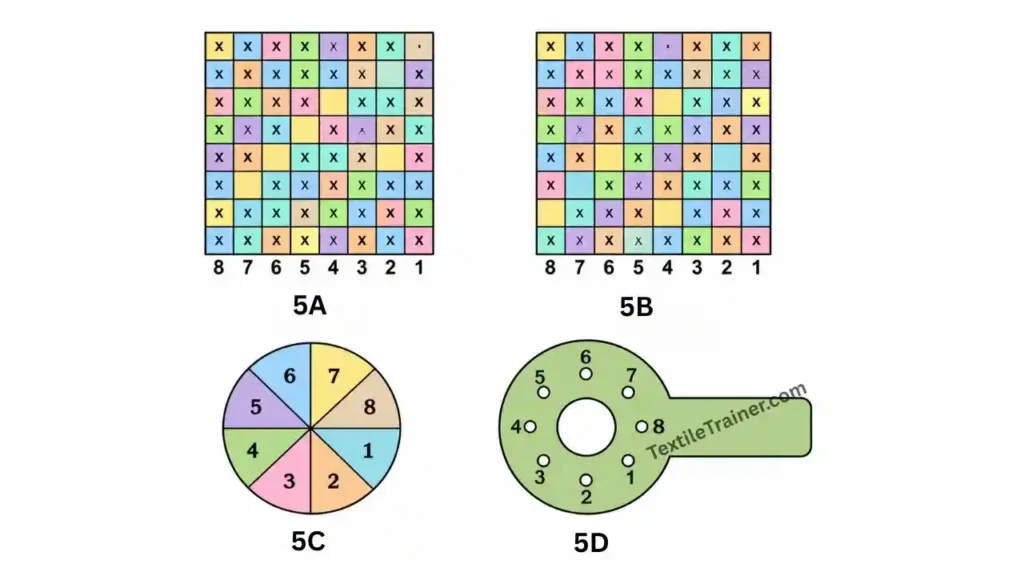
Two designs for eight shaft twill and stain are shown in figures 5A and 5. The repeat and picks to the round shown at figure 5C, and the outline of the tappet at figure 5D.
Conclusion
This is an overview of the shedding tappet construction for twill weave. For this twill fabric, there will be six treadles, each treadle being operated by a tappet of the same shape. But the tappet operating each succeeding treadle will be placed 600 of a revolution later than the previous one. So on till the sixth tappet and sixth treadle. This tappet is placed on the counter shaft, which must rotate once in six picks.
References
- banerjee, N. (2000). Weaving Mechanism. West Bengal: Smt. Tandra Banerjee and Sri Apurba Banerjee.
- Fox, T. W. (1992). The Mechanism of Weaving. Bombay : Universal Publishing Corporation .
- Gupta, R. S. (1977). Weaving Calculations . Bombay: D.B. Taraporevala Sons & Co. Private Ltd.
- V. Gordeev, P. V. (1982). Cotton Weaving. Russia: Mir Publishers Moscow.
Read more: