
Positive Tappet Shedding Mechanism in Loom Explained
Introduction
The positive tappet shedding mechanism will be discussed in this article. Generally, shedding is one of the primary motions in the loom. Warp yarns are separated into two layers to pass weft yarns during the shedding time. There are three types of shedding mechanisms. Tappet shedding mechanism is one of them. Tappet shedding mechanism is divided into two group.
- Negative tappet shedding mechanism: In the negative tappet shedding mechanism, the heald of the loom moves upward by the force of the tappet. But, heald moves downward by the help of spring or dead weight. In this mechanism, the heald frames depend on the springs or dead weight.
- Positive tappet shedding mechanism: In the positive tappet shedding mechanism, heald moves upward and downward by the help of mechanical tappets. In simple words, the tappet directly controls both upward and downward motion of the heald frames of the loom during the weaving process. In this mechanism, the heald frames do not depend on springs or dead weight.
Main Parts of Positive Tappet Shedding
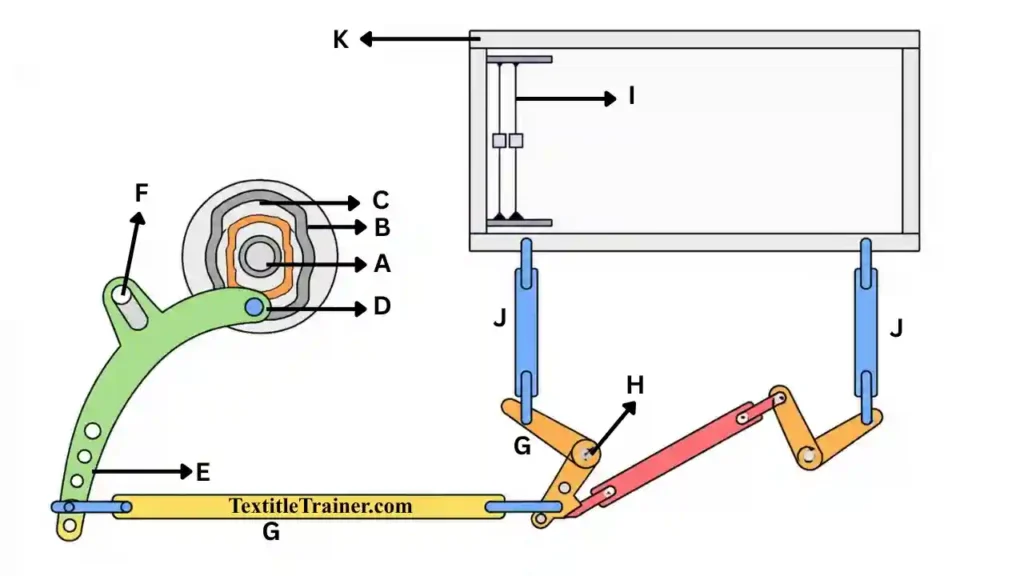
| A- Cam (tappet) shaft | G,J- Link rods |
| B- Cam (tappet) | I- Heald wire |
| C- Track (groove) | K- Heald shaft |
| D- Bowl | L- Oscillating link |
| E- Cam (tappet) lever | S- Stirrup |
| F, H- Fulcrums |
Working Principle of Positive Tappet shedding
There is a positive cam-shedding mechanism shown in Figure 1. A cam with a groove fits on the camshaft. A bowl fits in the groove. Connecting rods connect the heald shafts to one end of the cam lever with a fixed fulcrum. Based on the camshaft, the bowl moves and follows the groove path, transferring the motion to the link rods, which then transmit the upward or downward movement to the shafts, depending on the position of the bowl in the cam groove. This kind of shedding is positive shedding, since the cam controls the upward and downward movement of the heald shafts. There are as many cam units as there are working heald shafts. The tappet- or cam-shedding mechanism may be located inside or outside the loom.
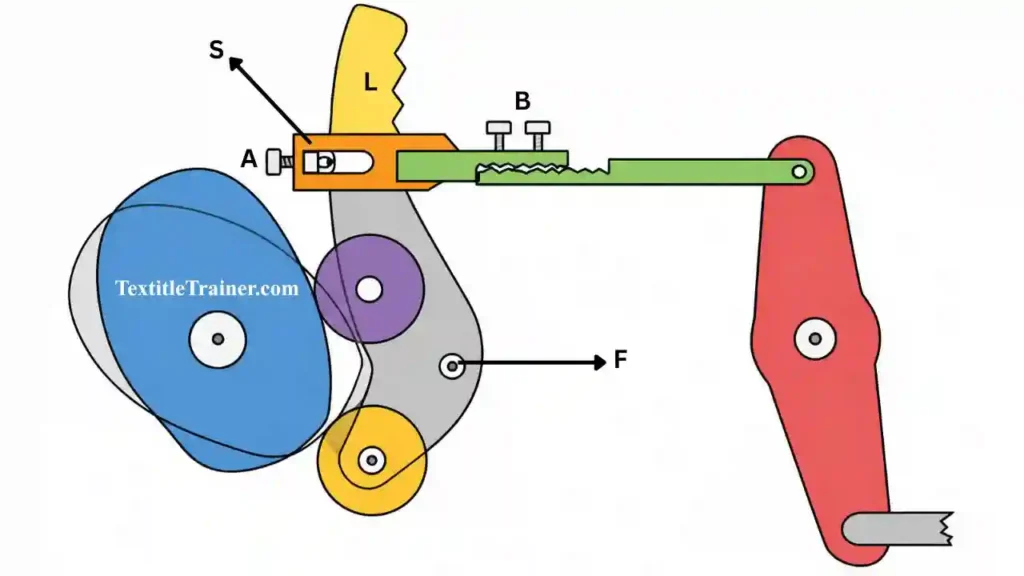
Figure 2 illustrates a double cam shedding system on a Sulzer loom. This system consists of two matched cams mounted on a shaft and an oscillating link (L) whose fulcrum is fixed at F by two antifriction rollers connected to each cam face. Each double cam has its own anti-friction roller, and there are as many double-shedding cams and motion transmission mechanisms as there are shafts. When a cam continuously rotates in a clockwise direction, the oscillating lever swings in clockwise and counterclockwise directions, dwelling at the end positions as necessary. A series of links connect the oscillating levers to the heald shafts and, finally, their clockwise and counterclockwise movements are transmitted to the shafts as upward and downward movements respectively. Shed depth is adjusted at A by moving the stirrup (S) up or down, but shed height is adjusted at B.
Positive Vs Negative Tappet Shedding
| Feature | Positive Tappet | Negative Tappet |
| Movement | Positive both direction | One direction positive |
| Control | Better control | Less control |
| Speed | Higher | Moderate |
| Maintenance | Low | Moderate |
FAQs
- What is tappet shedding in weaving?
- Tappet shedding is a mechanical system used to raise and lower heald frames to form a shed for the weft yarn insert.
- Where is tappet shedding used?
- Generally, tapped shedding is used in weaving looms for simple fabrics like plain and twill fabric manufacturing.
- What is the limitations of tappet shedding?
- The major limitation of tappet shedding is produce limited patterns. It is usually controls limited number of heald frames, often up to 8-10. Hence, it cannot produce complex fabric designs.
- What is the difference between positive and negative shedding?
- In the positive tappet shedding, both upward and downward movement of healds controlled by the cam or tappet. On the contrary, negative tappet shedding controls only the upward direction by using the tappet, while the downward movement depends on springs or dead weight.
- Why is the maximum tappet 8 for tappet shedding?
- In tappet shedding, shafts are moved up/down using tappets and cams. Because the mechanism is bulky, it can only handle up to eight shafts at a time. Thus, tappet shedding is the simplest and least versatile. Additionally, each tappet can control one heald frame. When the number of tappets increases, the size of the tappet wheel also increases. A larger wheel needs more space, resulting in it being difficult to install in the loom. Hence, the maximum tappet is 8 for tappet shedding.
Conclusion
To cut a long story short, the positive tappet shedding mechanism is widely used in weaving looms. It provides positive motion both up/down wards move of the heald. This mechanism is simple and durable. But, it is not possible to produce a complex design by using the tappet shedding mechanism.
References
- Arora, J. (2011). Modern Weaving Technology. Delhi: Abhishek Publications Chandigarh.
- banerjee, N. (2000). Weaving Mechanism. West Bengal: Smt. Tandra Banerjee and Sri Apurba Banerjee.
- Fox, T. W. (1992). The Mechanism of Weaving. Bombay : Universal Publishing Corporation .
- Murphy, W. (2009). Handbook of Weaving. Delhi: Abhishek Publicaitons Chandigarh.


