Comb Sorter Diagram: Measure Fiber Length Easily
Experiment Name
Study on the measurement of cotton fiber length by using a comb sorter diagram./ Draw a comb sorter diagram and measure the cotton fiber length (Mean length, effective length, staple length, dispersion. )
Introduction
Except silk, most natural fibres are discontinuous in nature. Natural fibre length varies greatly from plant to plant. Cotton fibre length, for example, varies according to the fibre type, such as Egyptian, Sea Island, American, Indian, and so forth. In the case of wool, fibre length varies not just between different types but also within a single plant. Fibre length varies not only between ships but also between different parts of a ship. An important aspect of yarns and fabrics is their fibre length, which impacts their physical and mechanical properties to a great extent.
Additionally, knowing the fibre length is also necessary to set the spinning process accordingly. It is extremely important to measure fibre length and its related characteristics since the length of natural fibre varies greatly and is one of the most important parameters determining the quality and price of a product. A variety of techniques are available for assessing cotton fiber length. Below are a few methods that can be used.
- Hand Stapling Method.
- Mechanized Stapling Method.
- Comb Sorter Diagram Method.
- Photoelectric Sensing Method.
- Single Fiber Length Measurement.
- Length Measurement by Weight.
- Clamp Tuft Method.
However, this experiment is about the comb sorter diagram. From this experiment, one can learn how to measure cotton fiber length by using a comb sorter diagram. Additionally, how to generate a comb sorter diagram in an easy way.
Read: Yarn Twist Tester Easy Working Principle:ISO 2061
Objectives:
- To learn the importance of measuring cotton fiber length.
- Come to learn how to generate a comb sorter diagram.
- To learn how to measure cotton fiber length by using a comb sorter diagram.
Apparatus
- Comb sorter
- Black velvet pad
- Dip presser
- Scale
- Griper
- Cotton fiber
Working Procedure
A comb sorter is used for cotton fibers. Working procedure is divided into two sections: 1) Fiber preparation, 2) Draw Comb Sorter Diagram
1. Fiber Preparation
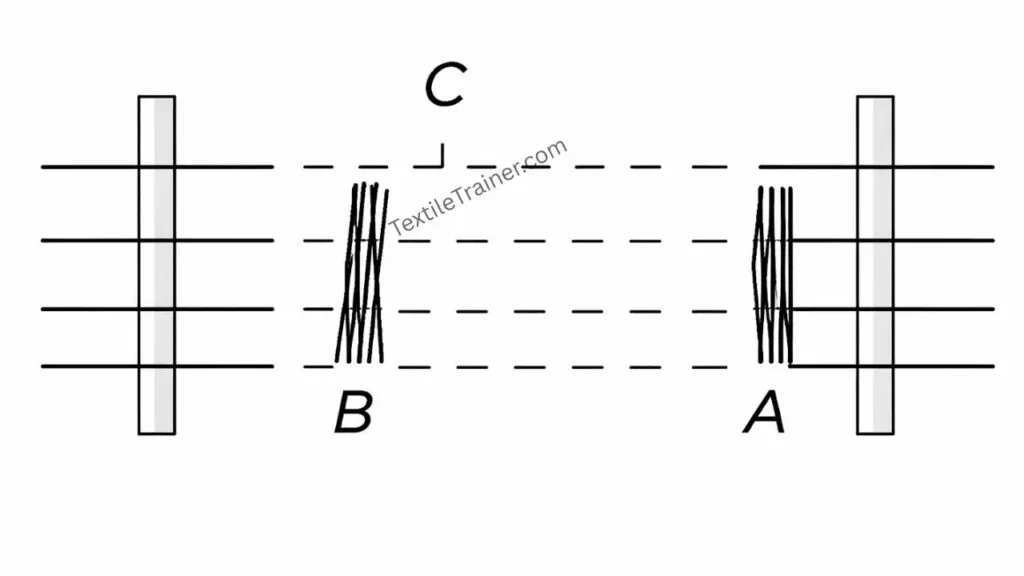
- Placing the Sample on the Comb: The comb sorter should be placed with the back facing the operator. The top combs should be lifted. The prepared fiber sample should be slightly twisted and placed in the lower combs on the right-hand side of the sorter. A small tuft of fibers should project outward.
- Removal of Loose Fibers: Then, loose fibers are removed from the projecting end until a straight edge is formed. This straight edge is marked as point A.
- Combing and Transferring to the Left Side: Subsequently, a small tuft is pulled from the sample and combed several times. After combing, the fibers are transferred to the left-hand side of the sorter (BC). The fibers should be arranged straight and at right angles to the comb.
- Repeating the Process: The above process is repeated until all the lint samples are transferred to the left-hand side of the sorter.
- Turning the Sorter: Now, the sorter is then turned around so that the front faces the operator. The longest fibers should project toward the operator.
- Lowering the Top Comb: The top combs are lowered and fixed in the rack. This helps grip the fiber tuft properly.
- Dropping the Lower Combs: The lower combs are dropped one by one until the tips of the longest fibers become visible.
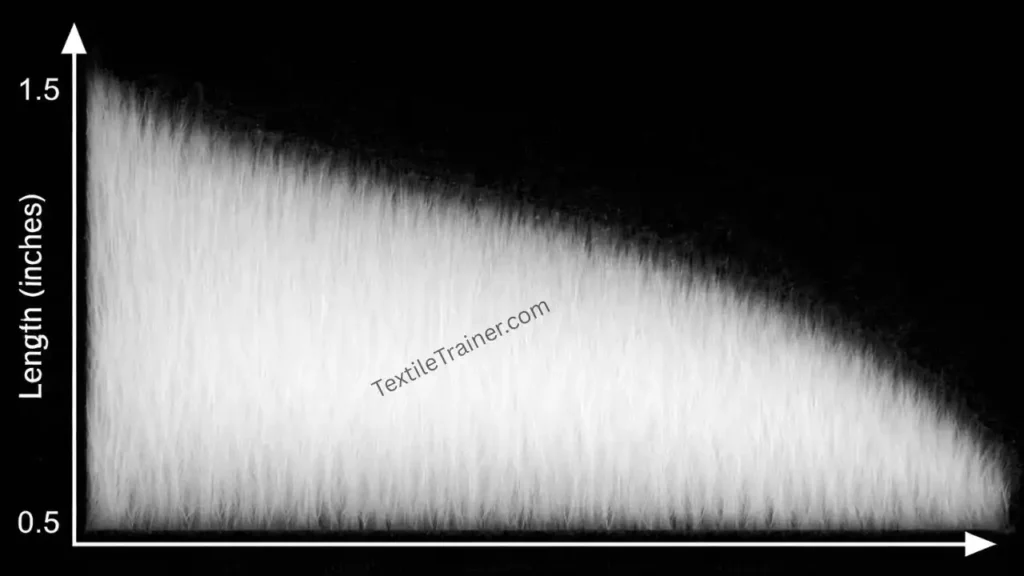
- Arranging the Fibers on the Velvet Pad: At last, the fibers are pulled out in tufts of gradually shorter length using the grip. The fibers are combed and straightened. Then, they are placed on the velvet pad with the straight edge aligned along the marked line, as shown in the figure.
Draw Comb Sorter Diagram
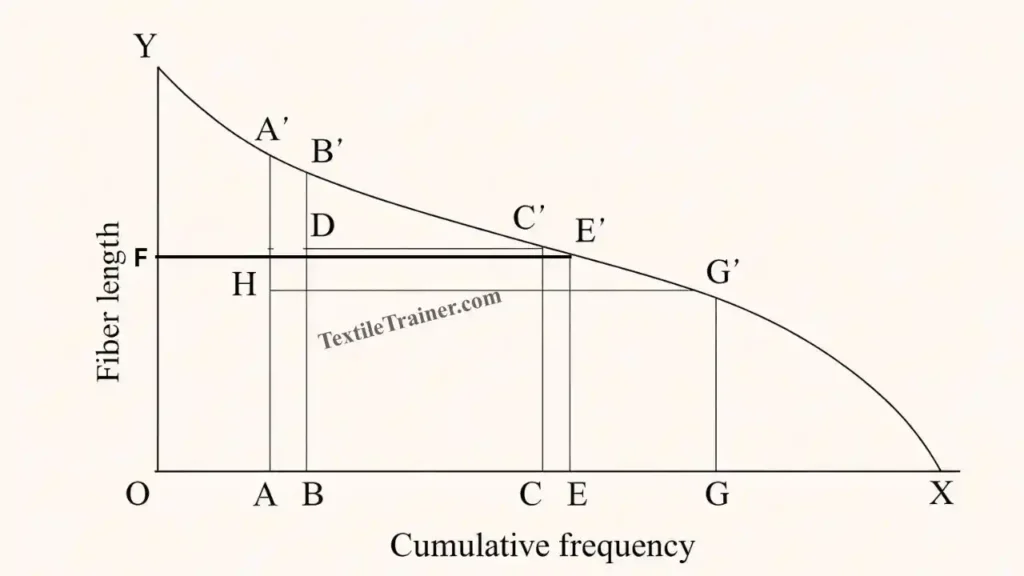
- Initially, a transparent poly paper is kept on the velvet pad. Let’s, the bottom line of the fiber is the X-axis , and the longest fiber length side is the Y-axis. Now, draw the line according to the fiber length on the poly paper.
- In Figure 3 shown, OY is the length of the longest fiber in the fiber specimen. Additionally, F is its center point.
- Now, draw a parallel line to the X-axis from the point of F. The parallel line intersects the curve at point E’.
- Then, a perpendicular line is drawn from E’ to the X-axis. This line intersects the X-axis at point E.
- Now, point A is marked on the X-axis as if the length of OA is equal to 1/4 of the length of OE.
- Subsequently, draw a vertical line intersecting the curve at point A’ from point A.
- An intersecting horizontal line is drawn at point G’ from the centre of line AA, namely point H.
- Now, from point G’, a perpendicular is drawn that intersects the X-axis at point G.
- OG length is again divided into four equal parts. OB is the upper quarter, and CG is the lower quarter.
- Next, from both points ‘B’ and ‘C’, perpendiculars are drawn that intersect on the curve at points Bʹ and Cʹ, respectively.
- Finally, A perpendicular line is drawn on the line BB’ from point C’ to point D.
Comb Sorter Diagram Analysis
- Men Length: Fibre mean length is defined as “the average length of all fibres in the test specimen”. It can be measured via a weight method, a number method, or distribution curves such as comb sorter diagrams or fibrograms.
- Mean Length= Area under the curve (OYX) ÷ Length of the baseline (OX)
- Effective length (BB’) : An effective length is a measure of the length of the majority of fibres longer than the average length in a sample. It is always longer than the mean length. A spinning line where machine settings are made according to fibre length, namely roller settings, uses the effective length since it represents the longest part of the fibre.
- Staple Length: Staple length is defined by USDA as “the normal length of typical portion of staple fibers having relative humidity of 65% and temperature of 70°F without regard to value or quality”. In other words, it can be said that the staple length is a typical length where the majority of fibres remain within that length. According to the American standard, staple length is 0.91 times effective length.
- Staple length= 0.91 × Effective length
- Dispersion: In the comb sorter diagram illustrated in Figure 3, BB’ is the upper quartile length and CC’ is the lower quartile length after the second approximation. Effective length is the same as the upper quartile length (BB’) after the second approximation. Interquartile ranges indicate the variability of fiber lengths in the sample by comparing upper and lower quartile lengths. The dispersion is the ratio between the interquartile range and the upper quartile length and is expressed in percentage.
- Dispersion%= (Inter quartile range ÷ Upper quartile length) × 100= (DB’÷ BB’)× 100
Conclusion
Comb sorter is a simple tool. It is a useful tool for measuring cotton fiber length. By analyzing the comb sorter diagram, one can calculate the fiber mean length, effective length, and staple length. This experiment will help in our future life.
References
- Booth, J. (2008). Principles of Textile Testing. New Delhi: BS Publishers & Distributors.
- Das, A. (2024). Testing of Textile and Fibrous Materials. Oxon: CRC Press .
- Saville, B. P. (1999). Physical Testing of Textiles. New York: Woodhead Publishing Limited.
- Wang, L. C. (2008). Physical and mechanical testing of textiles. In Fabric Testing (pp. 90-124). New York: WoodHead Publishing Limited.
Read More