Latest Dobby Shedding Classification, Scope and Uses
Introduction
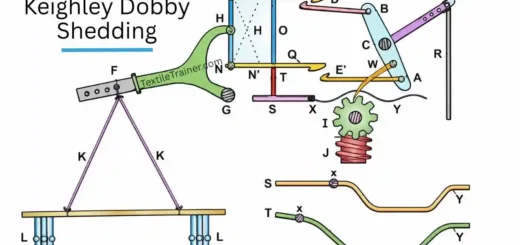
In this article, we will discuss the dobby shedding classification, its scope, and the uses of the dobby mechanism. We will also learn about dobby shedding before we move on to the main topic. By utilizing a larger number of healds than a tappet can hold, the dobby is placed at the top of a loom to produce figure patterns. By using warp threads and healds, dobbies are used in fancy weaving to produce small figures.
Scope of Doddy Shedding
The scope of dobby is limited between the uses of tappets and jacquards. When the number of shafts to be controlled or the picks to repeat of the design is beyond the range of the shedding tappet. Besides, the design is not economically produced by a jacquard. Then dobby shedding mechanism is used. It is also known as a “Witch” or a “Wizard”. The number of shafts which can be actuated by a dobby, varies between 6 and 40.

Doddy Shedding Classification
Some of the fundamental considerations involved in the design of a dobby are its position in the loom, figuring capacity, depth of shed, reversible motion of healds and speed of operation. However, doddy shedding may be classified in many ways. The following is the dobby shedding classification:
- According to figuring capacity ( No. of Heald shaft)
- 48’S, 36’S, 24’S, 20’S, 16’S, 12’S
- According to the diving of the heald shaft
- Positive dobby shedding
- Negative dobby shedding
- According to No. of Jack Lever
- Single jack lever
- Double jack lever
- According to lift
- Single lift
- Double lift
- According to the position of the heald shaft
- Vertical
- Horizontal
- According to shed
- Bottom close shed
- Centre close shed
- Semi-open shed
- Open shed
- Broadly dobby shedding
- Ordinary dobby shedding ( i.e. single jack lever, single lift dobby)
- Special dobby ( i.e. double jack lever, 48’S dobby)
Comparison Between Positive and Negative Dobby
| S/N | Positive dobby Shedding | Negative dobby Shedding |
| 1. | Positive dobby can raise and lower the healds shaft | It can raise the heald shaft and lowering is done by other mechanism or dead weight or spring. |
| 2. | Additional arrangement is not required | Additional arrangement required (dead weight, or spring) |
| 3. | Normally open shed is produced | Close/ semi-open shed is produced |
| 4. | High speed | Low speed |
| 5. | Less stress and strain on the warp | More stress and strain on the warp |
| 6. | Heavy fabric is produced | Light fabric is produced. |
Uses of Dobby Shedding
- There are 24-shaft dobbies in use in the cotton industry, but 16- and 20-shaft dobbies are most commonly used.
- It is very common for worsted industries to use dobbies with 36 jacks, which are positive in action and therefore ideal for heavy shedding.
- In addition to weaving twills, satins, and other simple weaves within the range of tappets, dobbies are also extensively used because they allow any number of shafts within their capacity to be used with greater facility and without extra costs or trouble, but at a greater energy consumption rate.
- The traditional shedding tappets have to be made for each pattern, but the healds work better and last longer when accurate by tappets; however, the dobbies offer greater flexibility for producing patterns with a greater number of healds.
- In a dobby loom, changing the pattern of the cloth is easy, while in a tappet loom, it is laborious and expensive and requires much more time, but a tappet loom has better shedding and produces higher quality cloth.
Conclusion
This is the dobby shedding classification. Dobby shedding is also known as “Witch” or “Wizard”. When a pattern is beyond the range of a tappet, or it is too small to be economically produced by a jacquard. Then, dobby shedding is used. However, it as question about the dobby shedding classification, scope of dobby shedding, feel free to ask me.
References
- Arora, J. (2011). Modern Weaving Technology. Delhi: Abhishek Publications Chandigarh.
- banerjee, N. (2000). Weaving Mechanism. West Bengal: Smt. Tandra Banerjee and Sri Apurba Banerjee.
- Murphy, W. (2009). Handbook of Weaving. Delhi: Abhishek Publicaitons Chandigarh.
More Article