Keighley Dobby Shedding Mechanism Easy Working Principle
Introduction
The original Keighley dobby shedding had some defects, that is, excessive wear and tear, slipping of needle collars, difficulty in making repairs, and a lack of stability. After the first quarter of this century, this dobby has been modified in many ways to meet both special and general requirements. The negative Keighlev dobbies are in general use. This dobby forms an open shed and is capable of running at a high speed.
The beating-up of weft is effected in a partially open, that is, crossed shed, which makes the cloth compact. Basically, it is a lever dobby with a horizontal lift, a double lift, and a single jack. The dobby is placed at one side of the loom top and is, therefore, in a convenient position for being attended to by the weaver. Keighley dobby shedding also known as Hattersley dobby shedding. The principle of this Keighley dobby shedding is illustrated in Figure 1.
Keighley Dobby Shedding
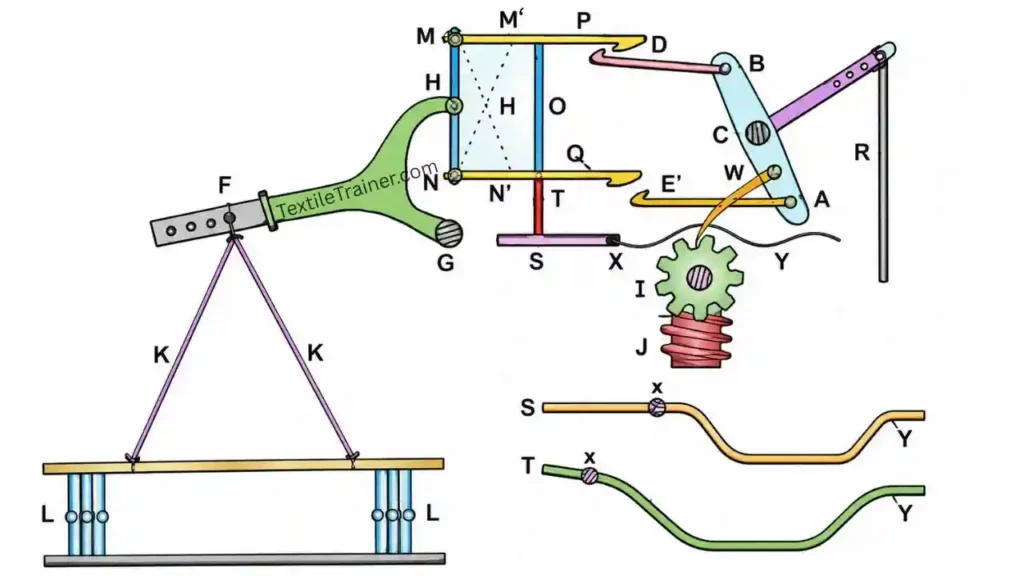
An upright rod R connects the dobby to a crank or L-lever on the bottom shaft one end. While the other end of the rod R is connected to the vibrating or T-lever AB. It is centered upon the rocking shaft C, which is the dobby shaft AB. The knives D and E are connected to the T-lever AB at B and A, respectively. Thus connected, it is obvious that with the revolving, movement of the bottom shaft the knives D and E will move in a reciprocating manner, forward and backward.
P and Q are two hooks, P being the top hook and Q the bottom hook. These hooks are respectively connected at the points M and N of the upright MN. The jack lever FGH. The fulcrum at G, is connected to the upright MN at H. The heald L is again connected to the jack lever at the outer end by means of V-cords or ends KK.
Suppose, when the knife D is in its innermost position, as shown in the diagram. The hook P is dropped on it. As the knife D moves, it will drag the hook P along with the upright MN, until MN assumes the position indicated by the dotted line, M’N, and the heald is lifted. If it is required to lift the same helad for the succeeding pick, the bottom hook Q is then dropped on to the knife E. Which at that movement will be in its innermost position just commencing its outward movement, and is taken forward by it until the upright MN assumes the position indicated by the dottel line MN’.
Since the top of the upright MN is moving backwards from M’ to M, while the bottom of the upright is moving forward from N to N’. The centre of the upright remains stationary at H’. Thus the heald remains up all the time, and the character of the shed is termed ‘open shed.
In this dobby a slight lateral movement accompanies each vertical movement of a heald, which is a defect. A single jack cannot exert a perfectly vertical pull on the heald as it described an arc of a circle while moving up and down. As with a single jack, a long heald cannot be satisfactorily controlled with V-cords. So it is only suitable for narrow looms.
Now, SY and TY are two series of levers or feelers held side by side, and for each jack there will be one SY and one TY, both centred upon the rod X. SY supports the top hook P through the upright O. While TY, which is a bent leer, supports the bottom hook Q directly. The hooks P and Q drop onto their respective knives as follows:
An octagonal prism, known as the boddy “barrel”, I, is held immediately below the levers SY and TY. Which are straight and bent levers respectively. Upon this barrel, a lattice J, composed of a number of strips of wood, perforated in double rows, known as ‘lags”, is mounted. Each perforated row on the lag will represent one pick, and the number of perforations in a row will indicate the capacity of the dobby. These perforations are pegged according to the pattern to be produced and a pegged perforation indicates its corresponding heald up.
If a peg pushes against the lever SY at Y, the end S will descend, so also the upright needle O, allowing the top hook P to drop on the knife D, when the latter is in its innermost position. In this way, the lever TY will allow the bottom hook Q to drop on the knife E, if required by the design. Thus, the leer H remains at H’ for both the picks.
The barrel is turned 1/8 of a revolution to place the next lag beneath the levers SY and TY for every two picks. This is done by hinging a jointed-pawl W upon a pin in the lower arm of the T-lever. With one movement of the arm, a pawl engages the teeth of a ratchet wheel on the barrel shaft, causing it to move forward. The lags and barrel are kept steady by bolting a flat spring to dobby framing and causing it to press upon the top of an eight-sided star wheel, which is fast upon the barrel shaft, V.
Conclusion
This is the Keighley dobby shedding mechanism’s working principle. Though it has some disadvantages. But it is used to make different types of complex design fabric. If you have any questions about Keighley dobby shedding mechanism, feel free to ask me.
References
- banerjee, N. (2000). Weaving Mechanism. West Bengal: Smt. Tandra Banerjee and Sri Apurba Banerjee.
- Fox, T. W. (1992). The Mechanism of Weaving. Bombay : Universal Publishing Corporation .
- Murphy, W. (2009). Handbook of Weaving. Delhi: Abhishek Publicaitons Chandigarh.
You May Read: