Climax Dobby Shedding Mechanism Explained and Its Uses
Introduction
Are you searching for the easy working principle of dobby shedding mechanisms? Yes, you are on the right site. This article is about Climax Dobby shedding mechanism and its uses. Generally, Single jack dobby shedding is suitable only for a narrow loom. But the double jack dobby is suitable for wider looms. Single jacks describe an arc of a circle as they rise and fall, while double jacks maintain heald under control and move perfectly vertically without any tendency to move laterally. A great adaptation of the Keighley dobby shedding is the Climax dobby shedding.Messrs. Lupton and Place, Burnley constructed climax dobby.
Key Components of Climax Dobby Shedding
- Jack Lever: Typically, lever ratios vary from 1:1.5 to 1:2.5 in order to convert hook strokes to openings between 70 and 90 mm. A jack is usually fitted on each shaft and pivots on a common shaft running across the dobby head.
- Rotary Eccentric: The rotary dobby (Stäubli 2670, Fimtextile) replaces the reciprocating knife with a continuously rotating eccentric, which removes the impact load and lets the head run at 1000+ PPM.
- Return Spring: The spring rate determines how stiff the dobby is and how soft the shaft is, so a stiff spring rate is better than a soft spring rate. Typical preload is 15-25 N per jack.
- Heald Shaft: In a dobby loom there are typically eight to forty shafts, each weighing 2-6 kg. Heald shaft must be lifted and dropped clean without overshoot every pick.
- Hook: Each shaft contains two hooks in a double-lift dobby – one for up-picking, one for down-picking – which doubles weaving speed by halving idle dwell. Hook nose hardness is specified at 58-62 HRC to withstand the cyclic impact.
- Pattern lag, Card: In mechanical lags, steel pegs are mapped 1:1 to shafts, and in electronic dobbies, solenoids are switched in 3-8 ms by a weaving controller from a stored weave file. A solenoid coil must maintain a resistance within 5% of nominal for selection to be reliable.
Working Principle of Climax Dobby Shedding
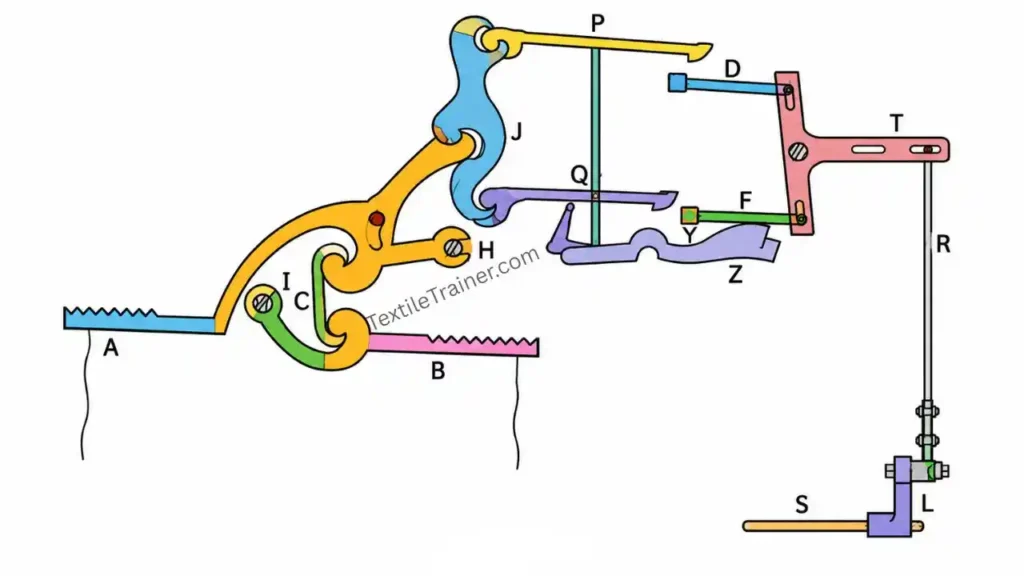
In this figure, A and B are two complementary jack-levers. They are operated from the same baulk lever J. J is controlled by hooks P and Q to govern the same heald. A pin centre the baulk-levers. The distinctive features of this dobby are the construction of the outer jack lever A in one part, instead of two parts. It is attachment with the inner jack, by means of a link C. the peg levers or feelers Y and Z. Y and Z are modifications of the levers SY and TY ( Please check Keighley figure).
It is sufficiently weighted at the back as if to make them fall by their own gravity. Other arrangements of the climax dobby shedding remain the same, like the Keighley Dobby Shedding Mechanisms. The upright R connects the dobby T lever in a slot with an L lever or a crank on the bottom shaft S. The jack levers A and B are fulcrummed at H and I, respectively.
There are double rows of holes in the lags on the pattern barrel or cylinder. The peg levers or feelers are acted by the pegs on the holes. Two rows of pegs act on the feelers Y and Z, respectively. The barrel remains stationary for two picks. Then, it turned 1/8 of a revolution to place the next lag beneath the feelers by a jointed pawl. A flat spring bolted kept the lags and pattern barrel steady to the dobby framing. Which presses upon the top of the eight-sided star wheel fixed upon the barrel shaft. These lags are placed on the dobby barrel or cylinder.
They are turned round a space of one lag by a pawl. Pawl fixed at the bottom of the T lever every two picks intermittently. It brings the next lag in the working position. Each lag operates the hooks for two successive picks. On row of pegs operates the top hook. The other row operates the bottom hooks. The T lever connects the top knife D and the bottom knife E. The T lever moves in a reciprocating manner in and out. The slots are meant for the proper adjustment of the knives.
Who Uses the Dobby Shedding
When a weaving operation requires more pattern complexity than a tappet (cam) loom can deliver but does not require thousands of independent ends, dobbies are a good choice. A tappet is for plain and twill fabrics with up to eight shafts; a dobbie is for geometric patterns with up to 40 shafts; a jacquard is for figured or pictorial fabrics with up to 40 shafts.
- Shirtng Fabrics: In Italy, Albini Group sources dobby-pattern cotton shirting with Itema R9500 rapier looms with 20 shafts.
- Heritage and Hand loom Weaving: Harris Tweed weaver croft houses still use Hattersley domestic dobby looms running 24-shaft lag-and-peg pattern chains for tweed twill structures.
- Wool Suiting: Italian mills such as Reda and Loro Piana use Vamatex Leonardo rapier looms with 24-shaft Bonas dobbies for fancy weave wool suits.
- Denim Weaving: At mills like Cone Mills’ White Oak (historically) and Kaihara in Japan, Picanol OmniPlus-i air-jet looms run 16-shaft Stäubli dobbies for selvedge denim.
- Terry Towel Production: Welspun India runs Egyptian cotton bath towel programs at 600 pieces per minute on Dornier P2 rapier looms with dedicated terry dobby heads.
- Technical and Industrial Fabrics: Manufacturers like GKD in Düren, Germany, use Sulzer projectile looms with rotary dobbies to weave multi-layer filtration fabrics.
Conclusion
In the climax dobby shedding mechanism, the hooks and knives move horizontally to produce a shed.This dobby shedding is negative in action. As springs are used beneath the healds for their undermotion. The type of the shed produced is an Open shed. Because the inward movement of the top hook corresponds with the outward movement of the bottom hook. However, I tried to best describe simply the working process of climax dobby shedding. If you have any questions about climax dobby shedding, feel free to ask me in the comment box below.
References
- banerjee, N. (2000). Weaving Mechanism. West Bengal: Smt. Tandra Banerjee and Sri Apurba Banerjee.
- Murphy, W. (2009). Handbook of Weaving. Delhi: Abhishek Publicaitons Chandigarh.
- V. Gordeev, P. V. (1982). Cotton Weaving. Russia: Mir Publishers Moscow.
- https://www.firgelliauto. com
You may read