Colorfastness to Crocking Test Explained AATCC TM 8
Introduction
Colorfastness to crocking is one of the most crucial quality tests. This test determines the color resistance of dyed or printed fabric when it comes into contact with other materials. If the dyed fabric releases dye during rubbing, it may stain other garments. This product reduces the customer satisfaction level. Hence, textile colorfastness testing is important. The AATCC TM 8 testing method is used to determine the colorfastness to rubbing properties of dyed and printed fabric. This method includes both dry crocking test and wet crocking test. Basically, the company does the colorfastness to crocking test to ensure the high quality of the fabric. However, this article will brief AATCC 8 colorfastness to crocking test with sample preparation. In simple words, from this article, one can learn A to Z colorfastness to rubbing test of the AATCC TM 8 testing method.
Read more: Colorfastness to Rubbing Easy Testing Procedure ISO 105X12
What is Colorfastness to Crocking ?
Colorfastness to crocking is the ability of dyed or printed fabric to resist its color during rubbing from one surface to another surface. The rubbing fastness test is an essential test among the other textile colorfastness tests, like colorfastness to perspiration, light, wash, and solvent, etc. Colorfastness to crocking is also called the colorfastness to rubbing test or rubbing fastness test. One important piece of information is that Colorfastness to crocking AATCC 8 is not recommended for use for carpets or for prints where the singling out of areas may be too small.
Principle of AATCC TM 8
The principle of colorfastness to crocking, AATCC TM 8, is simple. Initially, a dyed test specimen is rubbed with white crock test cloth under specific conditions. Owing to the rubbing, some color materials transferred to the white test cloth. Now, the white test cloth is assessed by a gray scale for color staining. Besides, the Chromatic Transference Scale can be used instead of the gray scale. But most of the factories use color staining, a gray scale for the rubbing fastness test.
Apparatus
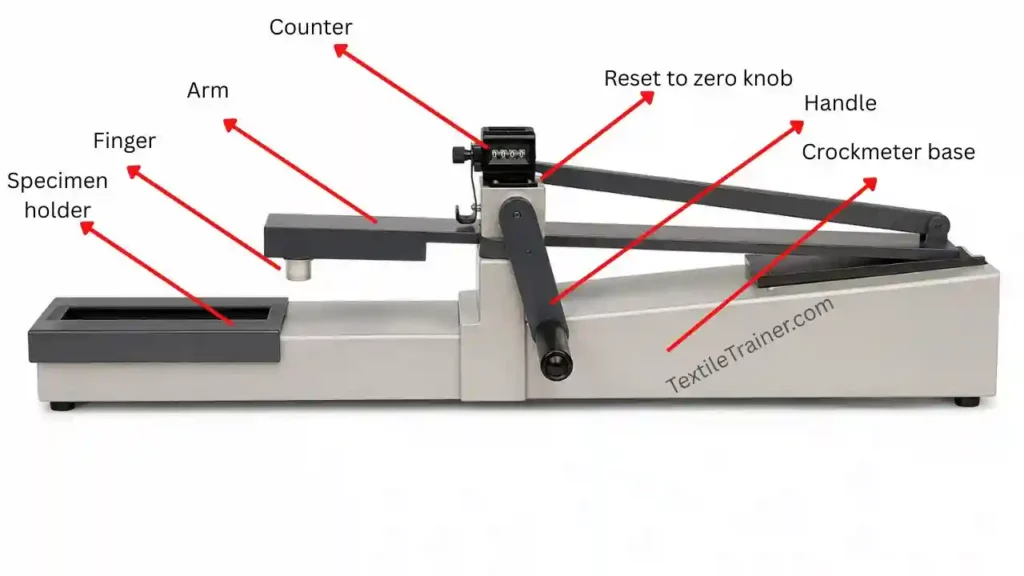
- Crockmete
- Finger diameter: 16 ± 0.3 mm, Moves back and forth,
- Straight line track length: 104 ± 3 mm,
- Downward force: 9N ± 10% (2 lb ± 10%)
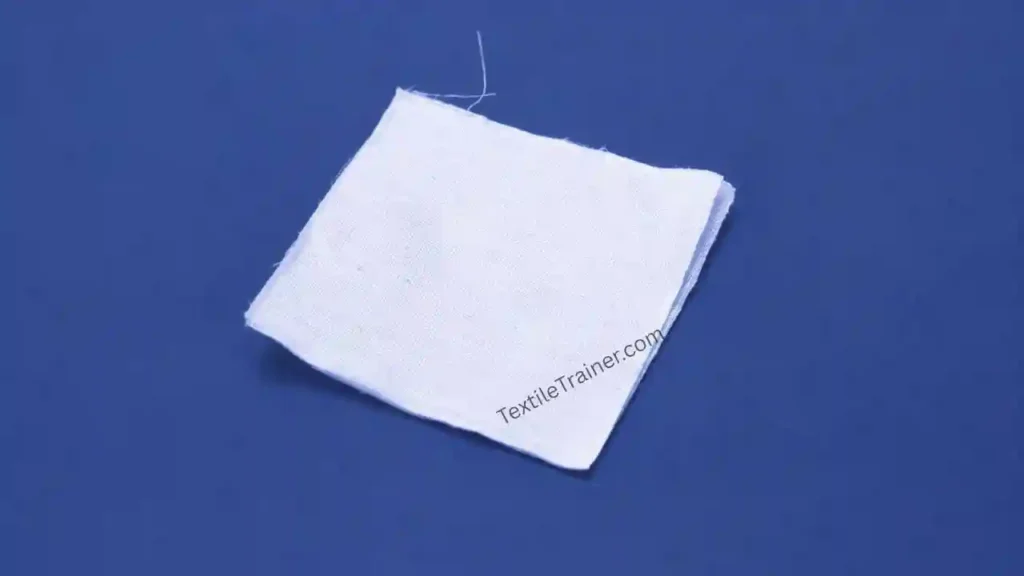
- Crockmeter Test Cloth, cut in 50 mm squares. The specification of crockmeter test cloth is given below:
- 100% 10.3-16.8 mm combed cotton staple with no optical brightener present
- Yarn 15 tex (40/1 cotton count),5.9 turns/cm “z”
- Thread count for greige fabric 32 ± 5 warp ends/cm: 33 ± 5 picks filling/ cm
- Weave 1/1 plain
- Finished fabric desized and bleached with no optical brightener or finishing material present
- pH 7 ± 1
- Mass/sq meter 100 ± 3 g finished
- Whiteness W = 78 ± 3
- AATCC Gray Scale for Staining EP-2
- AATCC9 step chromatic transference scale EP8
- Abrasive paper
- White AATCC Textile Blotting Paper
- Specimen Holder for crockmeter
- Wire clip
Read more: Colorfastness to Perspiration Test Method Explained AATCC TM15
Parts of Crockmeter
Test procedure of Colorfastness to Rubbing
Preparation Test Specimen
- Fabric specimen:
- Two specimens are used for the colorfastness to crocking test; one for the dry crocking test, and the other for the wet crocking test.
- Initially, the specimens are cut at least 50 × 130 mm (2.0 × 5.1 in.). Place the test specimen with its longer side at an oblique angle to the warp and weft or the wales and courses.
- For yarns: initially, a piece of knit fabric cut into 50 × 130 mm. If knit fabric is not available, wind the yarn tightly around a suitable form measuring at least 50 × 130 mm. Ensure that the yarn runs along the long direction of the form. Keep the yarn tightly wound or properly stretched during sample preparation.
Conditioning
According to ASTM D 1776, prepared specimen are conditioned for the colorfastness to crocking test. At least 4 hrs in an atmosphere of 21 ± 2°C and 65 ± 5% RH by laying each test specimen or crock square separately on a screen or perforated shelf of the conditioning rack.
Dry Crocking Test
- The test specimen should be placed flat on the abrasive cloth with its long dimension in the direction of rubbing on the base of the crockmeter
- Then, Make sure specimen holder is placed over specimen to prevent slippage.
- Place a white test cloth square, woven parallel to the direction of rubbing, over the end of the finger that protrudes downward from the weighted sliding arm.
- Next step, position the loops of the special spiral wire clip upward. If the loops are pointing downward, they can drag against the test specimen.
- Subsequently, starting with the finger positioned at the front end, set and run the motorized tester for 10 rotations.
- Condition and evaluate the white test cloth square after it has been removed.
- If the crock circle is napped, brushed, or sanded, remove the extraneous fiber by pressing lightly with cellophane tape on the sticky side before evaluating.
Wet Crocking Test
- Initially, prepare wet crock cloth squares by weighing a conditioned square, then thoroughly wetting out a white testing square in distilled water (using a syring tube, graduated pipette, or automatic pipette).
- In an example, if the crocking square weight equals 0.24 gm, the amount of fluid used would be 0.24 x 0.65 = 0.16 mL. Ensure 65 ± 5% wet pickup.
- The moisture content must not be reduced below the specified level by evaporation before the actual crock test.
- Follow the instructions for the dry method as described.
- Finally, after air drying the white test square, condition it before evaluating it.
Result
| Sample No | Dry crocking test | Wet crocking test |
| Sample-1 | 4 | 4 |
| Sample-2 | 5 | 3-4 |
| Sample-3 | 4-5 | 3 |
| Sample-4 | 4 | 4 |
| Sample-5 | 4 | 3 |
| Average | 4 | 3 |
Conclusion
Colorfastness to crocking is a crucial test for dyed fabric. The AATCC TM 8 standard provides a simple method for measuring colorfastness to rubbing in textile-dyed fabric. Both dry crocking test and the wet crocking test help factory owner to increase their efficiency as well as customer satisfaction.
Reference
- Booth, J. (2008). Principles of Textile Testing. New Delhi: BS Publishers & Distributors.
- Das, A. (2024). Testing of Textile and Fibrous Materials. Oxon: CRC Press .
- HU, J. (2008). Fabric Testing. New York: WoodHead Publising Limited.
- Saville, B. P. (1999). Physical Testing of Textiles. New York: Woodhead Publishing Limited.