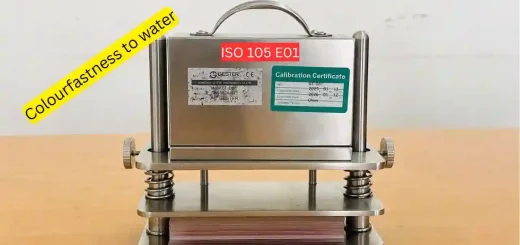
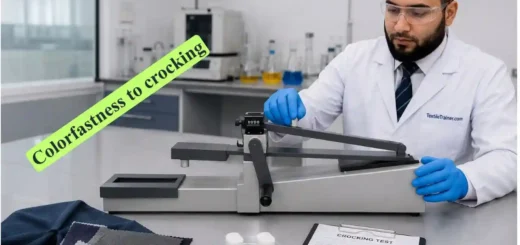
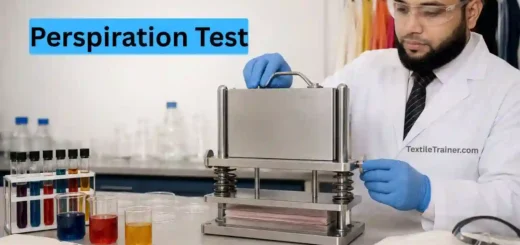
Colorfastness to Water Test Easy Procedure AATCC 107
Introduction
AATCC 107 is designed to measure the colorfastness to water of dyed, printed, or other colored textile materials like yarns, fabric. In colorfastness to water, distilled water or deionized water should be used. Because natural water has a variable composition that impacts the result. Hence, distilled water or deionized water is used for the colorfastness to water test. Additionally, AATCC 107, colorfastness to water test, determines the resistance of colored textile materials to change any of their color properties or the transfer of their color to adjacent materials. In this article, the AATCC 107 colorfastness to water testing method will discuss its principle and testing procedure.
You can read: Colourfastness to Water Test Explained ISO 105 E01
Principle of Colorfastness to water (AATCC 107)
Under specified temperature and time conditions, the specimen, backed by multi-fiber test fabric, is immersed in water. Then, it is placed between glass or plastic plates under specified conditions of pressure, temperature, and time. Finally, observe the change in color of the specimen and the staining of the attached multifiber test fabric.
Apparatus
- Perspiration tester (with acrylic plates)
- Distilled water or de-ionized water from an ion-exchange device.
- Drying oven—convection.
- Cold cut multifiber test fabrics (8 mm [0.33 in.] bands) containing acetate, cotton, nylon, silk, viscose rayon, and wool shall be used for specimens containing silk, or (8mm [0.33 in.] bands) containing acetate, cotton, nylon, polyester, acrylic, and wool shall be used for specimens with no silk present.
- Gray Scale for Staining (AATCC EP2 or EP12) or AATCC 9-Step Chromatic Transference Scale (AATCC EP8).
- Gray Scale for Color Change (AATCC EP1 or EP7).
- Wringer.
- Petri dish with a depth greater than 1.5cm and capable of containing a 6 x 6 ± 0.2 cm test specimen.
- Undyed adjacent fabric 6.9 White AATCC Textile Blotting Paper.
- Balance with a weighing accuracy of ± 0.001 g.
Testing Procedure of Colorfastness to Water
Test Specimens Preparation
- For fabric test: One specimen (6 x 6) ± 0.2 cm is required for fabric testing. Sew a single seam stitch along one edge of a (5 x 5)± 0.2 cm multifiber swatch to the face of the fabric.
- For yarn or loose fiber testing: weigh a multifiber fabric piece measuring (5 x 5) ±0.2 cm together with an undyed adjacent fabric measuring (6 x 6)± 0.2 cm. Approximately one-half of the combined mass of the adjacent fabrics should be taken as the mass of the yarn or loose fiber. Then sew the piece between two pieces of multifiber fabric measuring (5 x 5)±0.2 cm, as well as the undyed fabric measuring (6 x 6)± 0.2 cm.
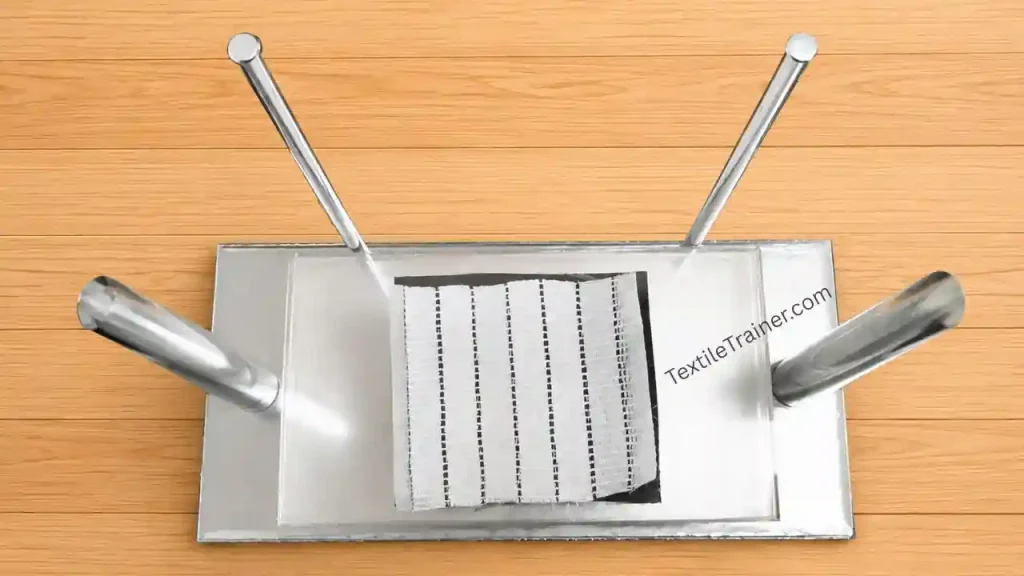
Colorfastness to Water Test Procedure
- Initially, Immerse each sample in a petri dish in the test solution (Distilled water or deionized water ), which is at room temperature, with occasional agitation to ensure thorough saturation (approximately 15 minutes for average fabrics).
- Noted, if fabrics are hard to wet out, immerse them at room temperature in the test solution, pass them through squeeze rolls, and re-immerse them. Repeat if necessary. When using the wringer, ensure there is an appropriate guard at the nip point. Do not remove the normal safeguards on the pad.
- Then, remove the test specimen from the test solution and pass each test specimen assembly through the wringer with the multifiber stripes perpendicular to the length of the wringer rolls (all stripes go through the wringer at the same time). Whenever possible, the wet weight should be 2.5-3.0 times the original weight. Make sure each test specimen weighs more than or equal to 2.5 times its original weight. Certain fabrics may not retain this amount of solution when passing through a wringer, so they should be tested after blotting to the required wet pickup with White AATCC Textile Blotting Paper.Subsequently, place the test specimen assembly between acrylic plates and insert it into the specimen unit of the perspiration tester. so that its multifiber stripes run perpendicularly to its long dimension.
- Depending upon equipment available, use the following alternates:
- In the horizontal perspiration tester, evenly distribute the specimen assemblies among the 21 plates. Place all 21 plates regardless of the number of specimens in the unit. Place the final plate on top, set the dual plates with compensating springs in place, and place the 3.63 kg (8.0 lb) weight on top, making a total of 4.54 kg (10.0 lb) under the pressure plate, and lock it in place using the thumb screws. Place the perspiration tester on its side in the oven so that the sides are parallel to the oven walls after removing the weight.
- Tester for vertical perspiration: Place all 21 plates into the tester with specimens evenly distributed among the 21 plates. No matter how many specimens you have, place all 21 plates. With a fixed metal plate on one end of the indicating scale and an adjustable metal plate on the other, the plates are held vertically between the scale and the indicating scale. Using the screw, exert a force of 4.54 kg (10.0 lb) against the plates. The specimen unit containing the test specimens must be locked with a set screw. Remove the pressure gauge unit from the specimen unit and place the unit in the oven so that the side of the perspiration tester faces the oven walls. Adding another specimen unit to the pressure gauge unit and repeating the loading procedure is possible.
- Then, loaded specimen unit should be heated in an oven at 380 C (1000 F) for 18 hours±5 minutes.
- Finally, the tester should be removed from the oven, and the multifiber fabric and, if used, the adjacent fabric should be separated from the test fabric. The multifiber fabric specimens should be placed on wire screens separately overnight according to ASTM D1776.
Evaluation of Colorfastness to Water Test
- By comparing the test specimen to the Gray Scale for Color Change (AATCC EP1) or using the Instrumental Assessment of Change in Color of a Test Specimen (AATCC EP7), you can determine the numerical rating on the Gray Scale that corresponds to the change in color.
- For color staining, assess the staining of the multifiber fabric using the Gray Scale for Staining (AATCC EP2), the 9-Step Chromatic Transference Scale (AATCC EP8), or the Instrumental Assessment of Degree of Staining (AATCC EP12), and record the numerical rating on each scale that corresponds to the appropriate one.
Result
| Description | Result |
| Color change | 4-5 |
| Color staining of acetate | 4 |
| Color staining of cotton | 3-4 |
| Color staining of nylon | 4 |
| Color staining of polyester | 3 |
| Color staining of acrylic | 4 |
| Color staining of wool | 4-5 |
Conclusion
AATCC 107 colorfastness to water measures the resistance of color regarding color change or color staining when the dyed textile materials come into contact with water. From this test result, manufacturer can improve their product quality. However, in the article, I tried my best to explore the colorfastness to water test procedure according to the testing method AATCC 107.
References
- Saville, B. P. (1999). Physical Testing of Textiles. New York: Woodhead Publishing Limited.
- Vankar, P. S. (2017). Natural Dyes for Texiltes (Sources, Chemistry and Applications). United Kingdom: WoodHead Publication.
- Wang, L. C. (2008). Physical and mechanical testing of textiles. In Fabric Testing (pp. 90-124). New York: WoodHead Publishing Limited.
Read more