
Cacao Husk Dye : Low Water Eco-Friendly Dyeing Process

Introduction:
This work used cacao husk dye as a natural dye. This dye is extracted from cacao husk. Many researchers are trying to reduce water in case of cotton fabric dyeing. They try to discover new eco-friendly dyeing process. So, many of them used synthetic chemicals instead of water. Cacao husk is an agricultural waste material. It can be used as natural dye. In this study, six cotton fabric samples were dyed using cacao husk dye. But, six samples dyed with different water concentrations. Here, 6%, 8%, 10%, 14%, 18%, and 22% water is used on the based of total liquor ratio. Residual liquor is used palm oil. Hence, palm oil partially reduce the water consumption.
The main aim of the work is to reduce water consumption during dyeing. Additionally, this study try to develop a eco-friendly dyeing process. Besides, Moderating process is skipped in this study. So, what color or shade will come? Is it possible to dyeing with cacao husk dye with mordent? Is it eco-friendly dyeing process or less water dyeing process?. We will find all the question’s answer the end the article.
You may Read: Eco-Friendly Denim Re-Dyeing Process with Charcoal
Why is Low Water Dyeing Important?
The textile dye houses are being targeted due to their colored. They also polluted effluents that are released into water bodies. There is a need to develop an alternative dyeing system that does not produce any hazardous effluent. But, totally water less dyeing is difficult and less productive. Hence, researcher is searching alternative of conventional aqueous dyeing method. They try to develop a new method where low water is used. The following the point of low water dyeing importance:
- Fabric dyeing factory uses a huge amount of water. Low water dyeing method will help to protect the fresh water.
- Besides, low water dyeing process means less waste water. So, it helps reduce environmental pollution.
- Additionally, low water dyeing means less chemical discharge into the rivers and canals.
- One the other hand, shortage of water is becoming a crucial problem in many countries. So, low water dyeing method can solve the problem.
Eventually, low dyeing method is important to protect our environment. However, this study will use cacao husk dye and try to use low water. Palm oil will be used as an alternative to water.
Required Materials and Machines
The following materials and machines are needed for eco-friendly cotton fabric by using cacao husk dye:
| 100% Cotton fabric | Cacao pod |
| Water | Palm oil |
| Fixing agent | Soaping agent |
| Solvent (ethanol) | Ultrasonic-assist extractor |
| Desiccator | Dyeing Machine and dryer |
Working procedure
The working procedure of cotton fabric dyeing with cacao husk dye is divided into 3 sections.
- Dye extraction
- Dyeing process
- Washing process.
1. Cacao Husk Dye Extraction
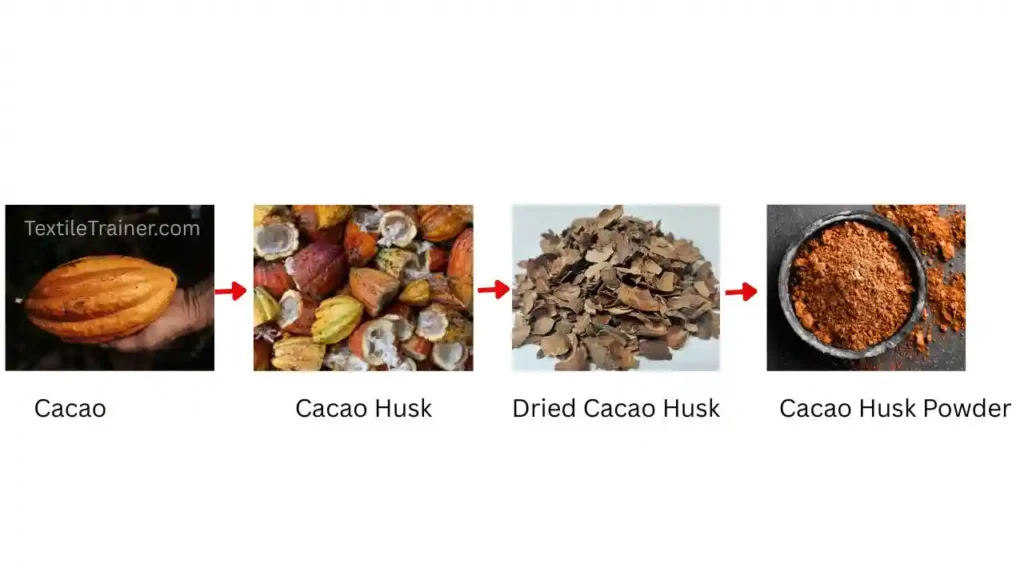
There are many natural dye extraction process. But this study will use an ultrasonic-assisted extraction process. The husk of the cacao pod was collected from the local factory. Then pod was cleaned water to remove impurities. Then, it cut into sample pieces. Subsequently, the cut pieces are dried under sunlight to remove extra moisture content. After 3 days, the pod became crispy. Now, it ground by using a blender. Then, it sifted by using a 60-mesh sieve.
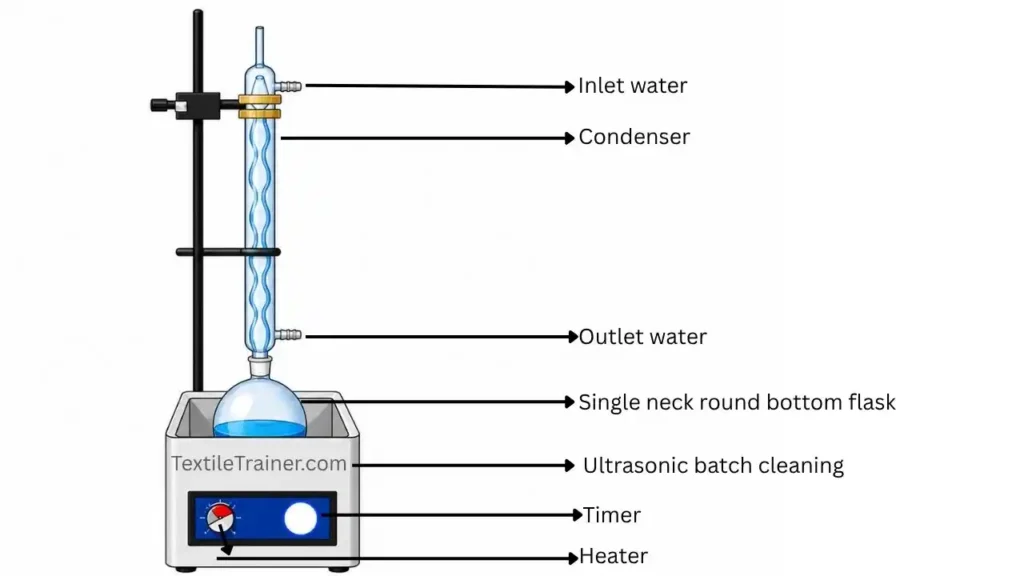
Now, cacao husk power was weighted 100 grams and add 500 ml ethanol (power: ethanol=1:5). The solution is treated at 700 C for 90 minutes using Ultrasonic assisted extraction. Extraction time was determined after reaching the temperature at 700C. After finishing the time, solution was filtered to remove residue from the solution. Now, the rotary vacuum evaporator is used to get extract cacao husk dye. This procedure was carried out under pressure 250 mbar and temperature about 70 0C. Then the extracted cacao husk dye found in paste form. The next process is used a desiccator until the paste become in power form.
2. Dyeing Process
The following recipe is used for the cotton fabric dyeing with cacao husk dye:
- Fabric weight= 2 gm
- Dye= 3% (on the weight of fabric)
- Fixing agent= 3%
- Soaping agent = 2%
- M:L= 1:25
- Time=60 min
- Temperature=800 C
| Sample No | Total liquor | Water(ml) | Palm oil | Cacao husk dye |
| Sample-1 (6%water) | 50 ml | 3 | 47 | 3% |
| Sample-2 (8% water) | 50 ml | 4 | 46 | 3% |
| Sample-3 (10% water) | 50 ml | 5 | 45 | 3% |
| Sample-4 (14% water) | 50 ml | 7 | 43 | 3% |
| Sample-5 (18% water) | 50 ml | 9 | 41 | 3% |
| Sample-6 (22% water) | 50 ml | 11 | 39 | 3% |
- Initially, 6 pre-treated samples are weighed, and the weight of each sample is 2 gm.
- Now, put the cacao husk dye, water, soaping agent and palm oil according to the recipe mentioned above.
- Then, set up the dyeing machine, 80 0C for 60 min, and run the machine.
- When the temperature reached 80 degrees, added 3 fixing agents.
- Subsequently, the dyeing machine is run at 800C for 60 min.
3. Washing Process
After the dyeing period ended, the samples were unloaded from the dyeing machine. Now, the sample is treated in ethanol at 950 C for 15 minutes. Finally, rinse with water.
Dyed Sample Overview
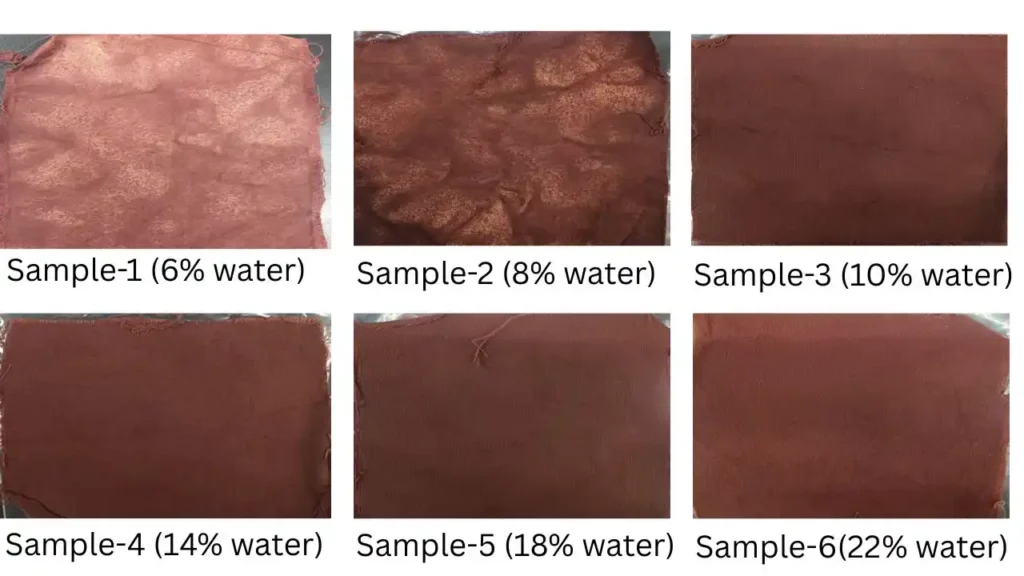
Result and Discussion
Visual Assessment
The samples were checked in a light box after drying. The samples were checked under D65 light. Visually, sample-1,2, 4,5,6 is uneven. That is the sample which is dyed with 6%, 8%, 14%, 18%, and 22% water, showing uneven shade. But the sample dyed with 10% water content is a better color shade than the other 5 samples.
The effect of water on k/s value
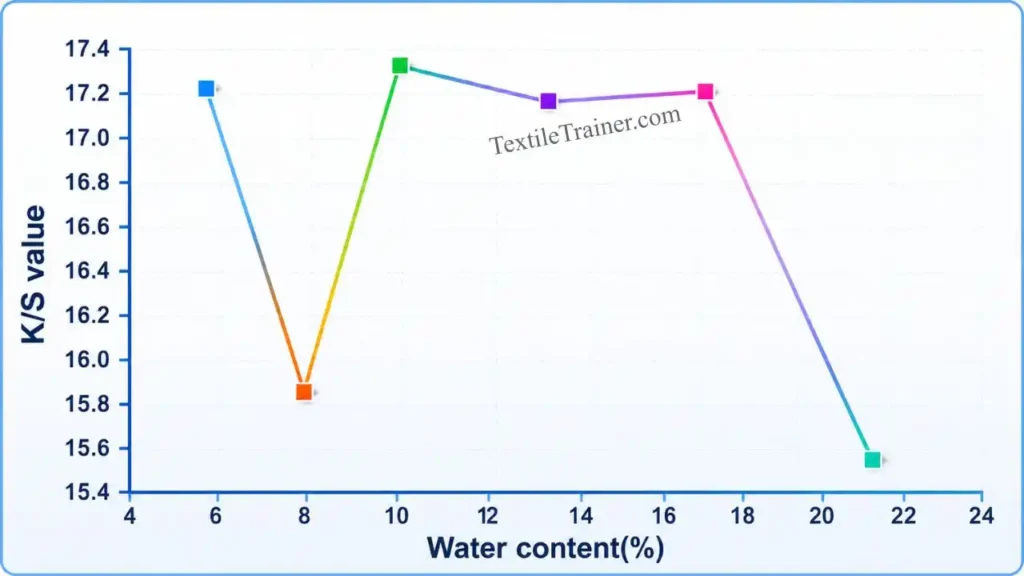
Graph 1 shows the effect of water content (%) on K/S value. The k/S value at 6% water is about 17.2. It is considered to have a high color intensity. But the value significantly drops to 15.9 ( sample dyed with 8% water content). Now, K/S value is drastically increased to 17.3, which is the highest value among the other 5 samples. This sample is dyed with 10% water content. At water content 22%, the K/S value sharply decreases to 15.6, which is the lowest value among the other 5 samples. Finally, we can say that, at 10% water content, the sample shows better color strength and better color shade.
The effect of fixing agents on k/s value
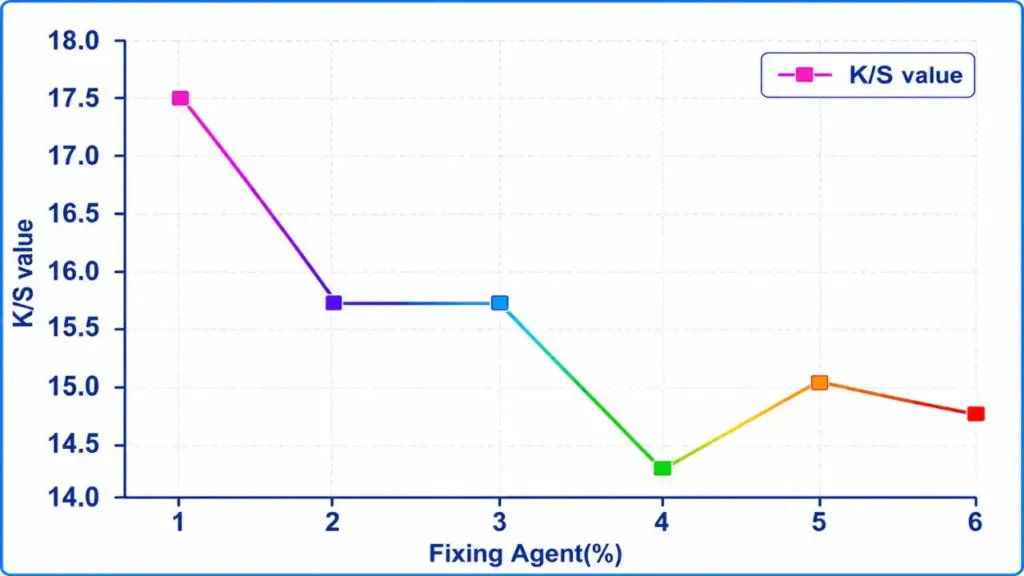
At 10% water content, the sample shows a better shade of color. Now, 6 sample is dyed with 10% water content, temperature at 800C, time 60 minutes. But the fixing agent has changed. Fixing agent is used 1%, 2%, 3%, 4%, 5%, and 6%. The graph-2 show the changing the amount of fixing agent changes the K/S value. The sample dyed with 1% fixing agent shows the highest K/S value. At 4% fixing agent shows the lowest color strength. So, the optimum level of fixing agent in case of cacao husk dye is 1%.
The effect of temperature on k/s value
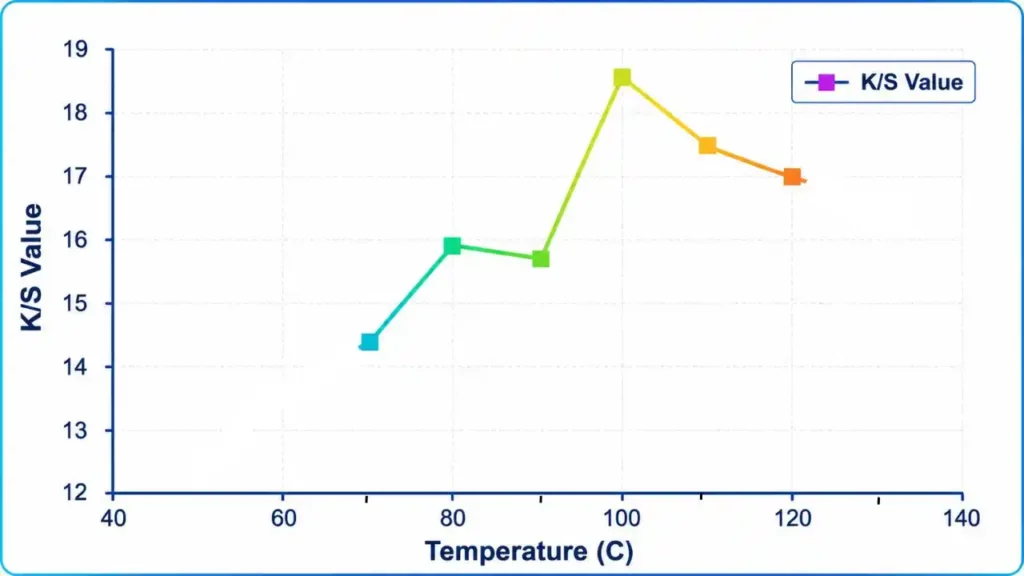
At 10% water and 1% fixing agent, cacao husk dye gives better color strength. Now, the sample is dyed at different temperatures(700C, 800C, 900C, 1000C, 1100C, and 1200C) to find out the optimum temperature. Graph 3 illustrates the variation of the K/S value with the temperature (0C). The color strength is gradually increased 12.5 to 18.7 between the temperatures 700 to 1000C. Then, the temperature sharply decreased to 17. From the graph, the optimum temperature for cacao dye is 1000C. Because, at 1000 C, the sample shows better color strength.
The effect of dyeing time on k/s value
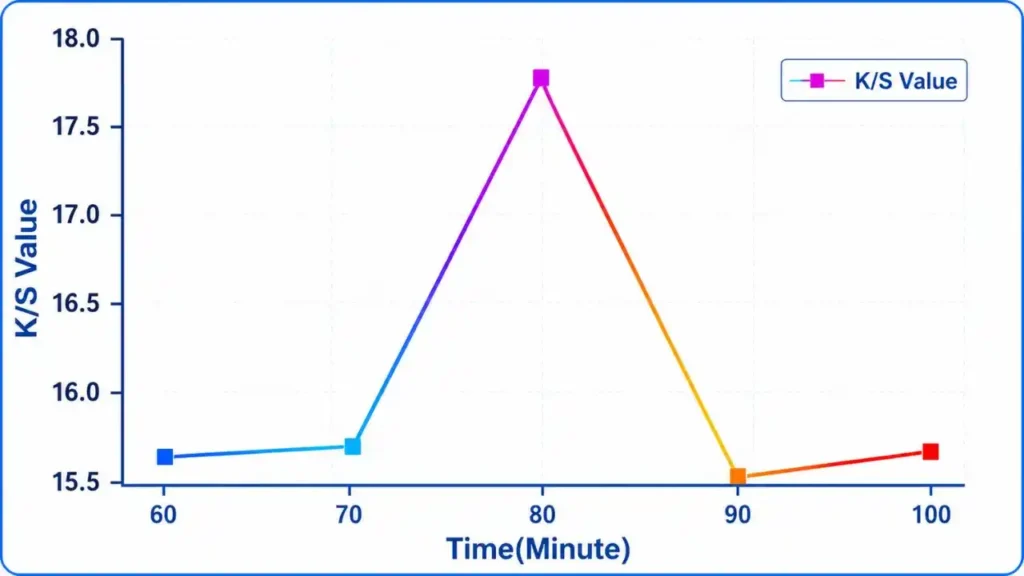
The dyed samples show better color shade at 10% water content, 1% fixing agent, and 1000C temperature. Now, the sample is dyed at different times (60 min, 70 min, 80 min, 90 min, 100 min, 110 min). The K/S value was between 15.5 and 16 at 60 to 70 minutes. But the value drastically migrated to 17.8 at 80 minutes, which is the highest color strength. Then, the color strength rapidly decreased to 15.5. However, the samples show better color strength at 80 minutes of dyeing time.
Optimum Cacao Husk Dye Parameter
The following parameters were found where cacao husk dye(3%) gives better color strength and shade:
| Water content | Palm oil content | Fixing agent | Temperature | Time |
| 10% | 90% | 1% | 1000C | 80 minutes |
Conclusion:
This work demonstrated the less water dyeing process of cotton fabric by using cacao husk dye. This work also fixed some optimum parameters where the cacao husk dye gives better results. I think this process is an eco-friendly process. Because this study used less water content with better color performance. Thanks for reading the article. You can drop your advice in the comment box below.
References
- F. Dye, “Jurnal Rekayasa Kimia dan Lingkungan Extraction of Natural Dyes from Cocoa Pod Husk ( Theobroma Fabric Dye,” vol. 19, no. 2, pp. 200–211, 2024.
- M. Y. Hossain et al., “Effluent-free deep dyeing of cotton fabric with cacao husk extracts using the Taguchi optimization method,” Cellulose, vol. 28, no. 1, pp. 517–532, 2021, doi: 10.1007/s10570-020-03525-8.
- M. Y. Hossain et al., “Adsorption, kinetics, and thermodynamic studies of cacao husk extracts in waterless sustainable dyeing of cotton fabric,” Cellulose, vol. 28, no. 4, pp. 2521–2536, 2021, doi: 10.1007/s10570-020-03662-0.
- C. Tu, “Study about Stability of Cacao Husk Pigment and its Dyeing Properties on Cotton,” in Wool and Textiles Sustainable Development, in Key Engineering Materials, vol. 671. Trans Tech Publications Ltd, 2016, pp. 133–138. doi: 10.4028/www.scientific.net/KEM.671.133.
- M. O. Olakunle, A. A. Inyinbor, A. O. Dada, and O. S. Bello, “Combating dye pollution using cocoa pod husks: a sustainable approach,” Int. J. Sustain. Eng., vol. 11, no. 1, pp. 4–15, 2018, doi: 10.1080/19397038.2017.1393023.
You may Read more Eco-friendly Process



Thank you vai
Thank you…
A good ecofriendly dye
Thank you. Please stay with us.