Weaving Shed Geometry in Loom with Proper Figure
Introduction
Shed formation in weaving is one of the most crucial primary motions of the loom. This article is about weaving shed geometry. In the weaving process, warp yarns are divided into two layers. The weft thread is inserted between two layers. Proper weaving shed geometry helps to increase weaving efficiency. Besides, well-woven shed geometry reduces warp breakage and improves weft insertion. On the contrary, shed geometry may cause yarn tension variation and fabric defects.
You May Read: 4 Types of Sheds in Weaving Loom: Easy Explained
What is Weaving Shed Geometry?
Weaving shed geometry refers to the shape, angle, and dimensions of the shed formed between warp yarns during weaving. Additionally, it includes the position of warp yarns, shed height, shed angle, and yarn path.
Weaving Shed Geometry
The warp line is split into two groups during weaving: the top (or upper) shed line and the bottom (or lower) shed line, by shedding, one of the three primary motions in weaving. Figure 1 illustrates a simple weaving shed geometry:
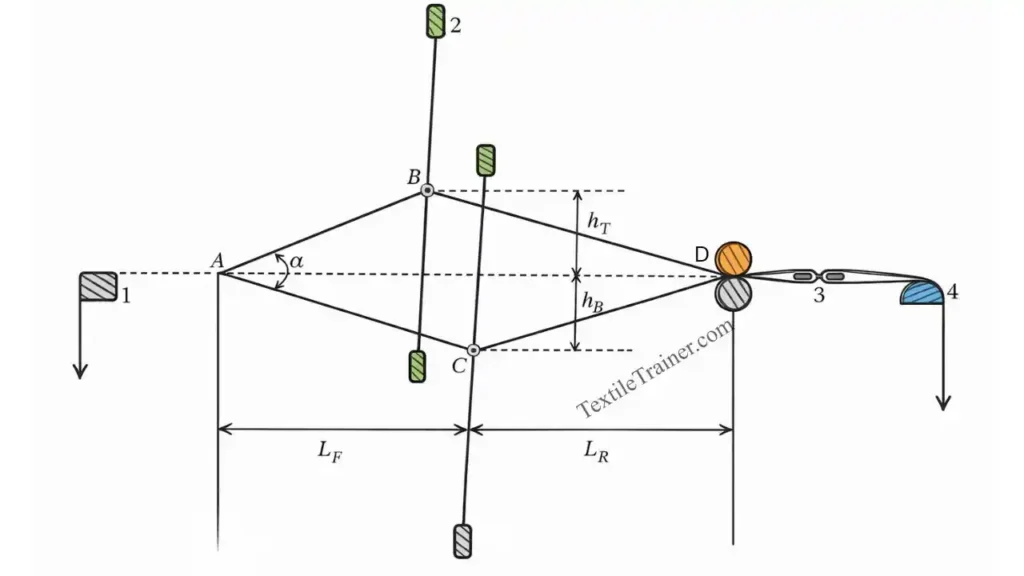
| ABCD | The front shed | 4 | Back rest |
| BCDB | The rear shed | Α | Shed angle |
| ABD | The top shed line | LF | Length of front shed |
| ACD | The bottom shed line | LR | Length of rear shed |
| 1 | Breast beam | hT | Lift of top shed line |
| 2 | Heald | hB | Lift of bottom shed line |
| 3 | Lease rods |
Heald is a most important element in the shedding process. Warp threads of the top and bottom shed lines are controlled by the respective heald eyes. The nature of movement of the healds as well as their lift along with their positioning with respect to the fell of the cloth A and the point D play decisive roles in the weaving process. Healds are moved by shedding systems, the simplest of which is controlled by shedding tappets.
Classification of Weaving Shed Geometry
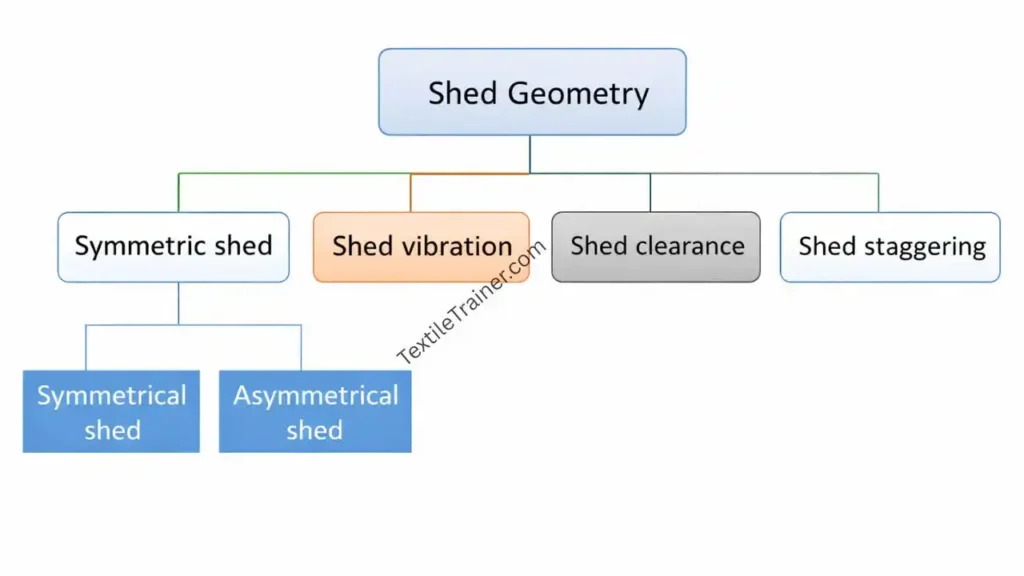
- Symmetric shed: a symmetric shed formed when the backrest and cloth roller are at the same height. Another word, a symmetric shed refers to the balanced movement of warp yarns above and below the center line. In this shed, the top shed and bottom shed are identical. The following the effect of symmetric weaving shed geometry:
- Due to the identical warp tension in top and bottom sheds, adjusting warp thread is easy.
- There is no rocking action in the adjustment. Otherwise, the shed looks flatter.
- Asymmetric shed: An asymmetric shed is formed when the backrest and cloth roller are not at the same height. In this shed, the top shed and the bottom shed are not identical. The following the effect of asymmetric weaving shed geometry:
- When the back rest is raised, the hypothetical line of minimum tension moves up, increasing the strain on the bottom shed.The cover of the cloth is improved.
- The vertical axis and horizontal axis of the lift of the shaft are asymmetrical.
- Shed vibration: shed vibration occurs due to rapid movement of heald frames during shedding.
- Shed staggering: Shed staggering refers to the slight delay in movement of heald frames during shedding. Instead of moving all warp yarns at the same time, they move gradually.
- Shed clearance: Shed clearance is the vertical distance between upper and lower warp yarn layers. It provides enough space for weft insertion.
Element of Weaving Shed Geometry
- Frame depth: The distance between the maximum height position and lowest height position in the frames is called frame depth or lever height.
- Frame height: It is the distance between two reference points.one reference point is on loom stationary structure and other one is on the heddle frame.
- Back rest height and depth: It is the most rear or back roller in the loom when warp yarns form shed. It is the most commonly used element in shed geometry. It controls the warp tension and controls pick density in the fabric.
- Front shed: It represents the triangular opening in front of the healds. This region extends from the fell of cloth (A) to the heald eye positions (B and C). The warp yarns diverge from point A and separate into upper and lower layers toward points B and C.
- Back shed: This region is located behind the healds. The warp yarns from B and C converge toward the back rest point (D), forming the rear triangular shed.
- Top shed line: The top shed line is the upper boundary of the shed. It is formed by connecting ABD. This line represents the path of the upper warp yarn layer from the cloth fell (A) through the upper heald position (B) to the back rest (D).
- Bottom shed line: The bottom shed line is the lower boundary of the shed. It is formed by connecting ACD. This line represents the path of the lower warp yarn layer from the cloth fell (A) through the lower heald position (C) to the back rest (D).
- Virtual shed dividing line: It is the line which divides the frame shed equally and parallel to the machine horizontal.
Conditions of Good Shedding
- A shed should be as small as the nature of the Work to be done will allow so as to prevent unnecessary breakages of the warp threads.
- Therefore, to obtain good shedding, healds are placed at right angles with the warp threads, and must be so connected to the shedding motion that a vertical pull will be exerted upon them. Even a slight lateral movement of healds is detrimental to good weaving.
- Another important conditions, over and under motions of healds must be regulated in such a way as perfect levelling of healds are obtained, when the shed is either open or closed.
- Finally, the velocity of the upward and downward movements of healds must be variable to correspond, as far as possible, with the tension upon the warp to avoid entanglement and breakages of warp ends. Shedding tappets should be constructed to give this eccentric movement to the healds. They must begin to move slowly and towards the centre of the shed mole fastest, as there is little or no stress on the yam, and gradually slower till the dwell is reached, and act alike in the opposite direction. It is evident that a movement of this kind puts as little strain as possible on the warp and causes the fewest breakages. To achieve this end, the lift of tappet has been divided into six unequal divisions. Again, to reduce strain on delicate yarns during beating up, some tappets have a slight inward curve on their surface and a slight elevation exactly opposite the depression, because these reduce the size of the shed during beating up.
Conclusion
Weaving shed geometry plays an important role in a weaving factory. This article tries to cover the weaving shed geometry with a classification of shed geometry and elements of shed geometry. If you have any questions about shed geometry, feel free to ask me in the comment box below.
References
- Arora, J. (2011). Modern Weaving Technology. Delhi: Abhishek Publications Chandigarh.
- Fox, T. W. (1992). The Mechanism of Weaving. Bombay : Universal Publishing Corporation .
- Gupta, R. S. (1977). Weaving Calculations . Bombay: D.B. Taraporevala Sons & Co. Private Ltd.
- Murphy, W. (2009). Handbook of Weaving. Delhi: Abhishek Publicaitons Chandigarh.
Read More