Colourfastness to Water Test Explained ISO 105 E01
Introduction
ISO 105 E01 is a method for determining the colourfastness to water. This method expresses the resistance of dyed textile materials against water. The ISO 105 E01 textile colourfastness testing process is a popular method among textile buyers. It measures both the color change and color staining properties of dyed fabric. This article will explain the principle of colourfastness to water and its testing procedure.
Read more: 3 Key Denim Testing Parameters for Quality Control
What is colorfastness to water?
Colourfastness to water is the ability of dyed textile materials to resist color change and color change against adjacent materials when exposed to water. This textile colorfastness testing method determines whether the fabric loses color or stains another fabric after it soaks in water.
Principle of Colourfastness to water ISO 105 E01
A specimen of the textile materials or dyed fabric in contact with either two single-fiber adjacent fabrics or multifiber adjacent fabrics. Initially, the specimen was sewn together with multifiber test fabric. Then the composite (specimen + multifiber) is immersed in water, drained, and placed on two plates under a specified pressure in a test device. Drying is done separately for the specimen and adjacent fabrics. Using the grey scale, we compare the specimen’s colour change and the adjacent fabric’s staining.
Apparatus
- Perspiration tester
- Weight piece
- Oven
- Acrylic plate (60mmX115mmX1.5mm) / 11 pieces
- Grade 3 water
- Flat-bottomed dish
- Grey scale for assessing change in colour as per ISO 105 A02 • Grey scale for assessing staining as per ISO 105 A03
- Spectrophotometer or colorimeter for assessing change in colour and staining, complying with ISO 105-A04 and ISO 105-A05.
- Multifiber test fabric (DW or TV)
- If required, non-dyeable fabric (for example, polypropylene). Refer to Table for adjacent complying F01-F07 selections
| If the first piece is | The second piece is to be |
| Cotton | Wool |
| Wool | Cotton |
| Silk | Cotton |
| Viscose | Wool |
| Polyamide | Wool or cotton |
| Polyester | Wool or cotton |
| Acrylic | Wool or cotton |
Specification of Grade-3 water
This specification is according to ISO 3696 for colourfastness to water
| Parameter | Data |
| pH at 250 C | 5.0-7.5 |
| Electrical conductivity | 0.5 ms/s at 25⁰ C |
| Oxidiazable matter | 0.4 mg/l (max) |
| Residue after evaporation | 2 mg/kg at 1100 C |
Colourfastness to Water Test Procedure
Preparation Specimen
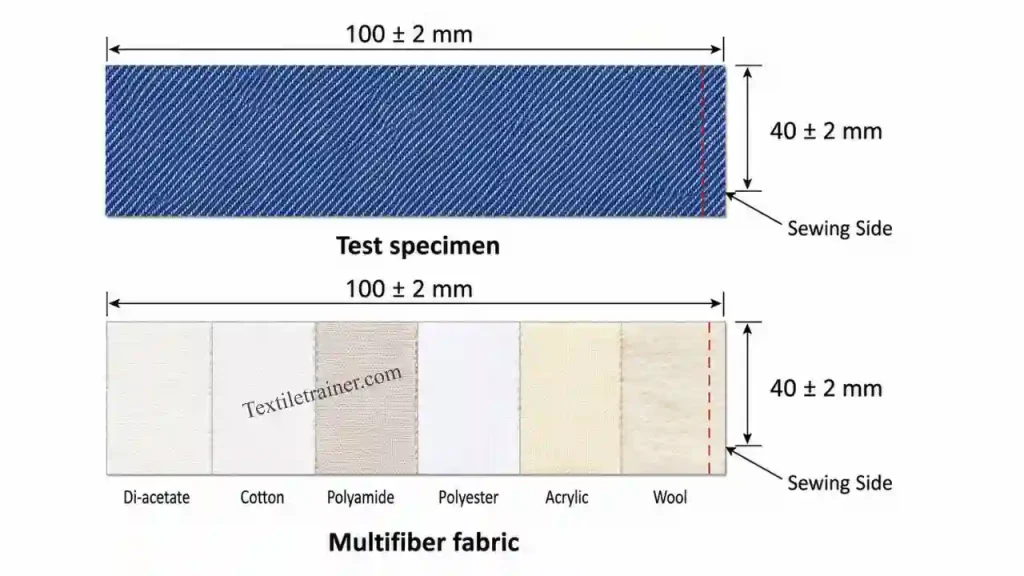
- Initially, the specimen is cut into 100 × 40 mm (±2 mm)
- In the same way, multifiber (DW or TV) test fabric is cut into 100 × 40 mm (±2 mm)
- Now, the specimen with the multifiber test fabric is sewn according to Figure 1
Test procedure
- At first, The composite specimen is weighed. Then, the composite specimen needs to be laid out smoothly in a flat-bottomed dish.
- At a liquor ratio of 50:1, thoroughly wet out the composite specimen in this solution. (Suppose the composite specimen weight is 2 gm. Then, 100 ml water is used to wet out the specimen). Now, it allows to remain in the solution for 30 minutes. The next steps are to press the specimen to remove excess water and to move it periodically to ensure uniform penetration of the solution.
- The solution should be poured off and the excess liquor wiped off between two glass rods.
- Now, the composite specimen is placed between two acrylic plates under a pressure of 12.5 Kpa,
- Preheat the test device to the test temperature and place in it.
- Place the test device into the oven for 4 hours at the temperature of 37°C, with the specimens either horizontally or vertically positioned.
- After 4 hours, the composite specimen is opened out (by breaking the stitching, except on the short side, if necessary) for drying.
Drying Procedure
- Dry the specimen by hanging it in the air at a temperature not exceeding 60°C.
- Specimens and adjacent fabrics is handled separately.
- In the case of yarn/loose fiber, remove the sewing at three sides.
Evaluation
Examine the specimen’s colour change with the ISO 105 A02 (Grey Scale for Assessing Change in Colour), and staining on adjacent fabric with the ISO 105 A03 (Grey Scale for Assessing Staining).
Result
The following the result of colourfastness to water:
| Description | Grade |
| Color change | 4 |
| Color staining to Di-acetate | 4-5 |
| Color staining to Bleached cotton | 4 |
| Color staining to Polyamide | 5 |
| Color staining to Polyester | 4 |
| Color staining to Nylon | 4-5 |
| Color staining to Acrylic | 4-5 |
| Color staining to Wool | 4 |
Conclusion
The colourfastness to water test (ISO 105-E01) is one of the most important textile colourfastness tests. This test measures the resistance of color of dyed fabric to water. It helps to manufacturers to improve their product quality. The colourfastness to water test also helps meet buyer requirements regarding colourfastness to water.
References
- Booth, J. (2008). Principles of Textile Testing. New Delhi: BS Publishers & Distributors.
- Das, A. (2024). Testing of Textile and Fibrous Materials. Oxon: CRC Press .
- HU, J. (2008). Fabric Testing. New York: WoodHead Publising Limited.
Read more