18 Garment Manufacturing Sequences: Design to Finished Product
Introduction
The garment manufacturing sequences are a series of processes. This processes use to make fabric into finished garments. Every step of the garment manufacturing process is crucial. Because it affects the quality, cost, and delivery time of the final goods. Well-decorated garment manufacturing sequences help the manufacturer earn maximum profit. Additionally, it also helps to reduce fabric defects and waste. The garment manufacturing flow chart starts with garment design and ends with shipment. This article will explain every step of the garment manufacturing flow chart.
Garment Manufacturing Sequences
The following are the garment manufacturing sequences:
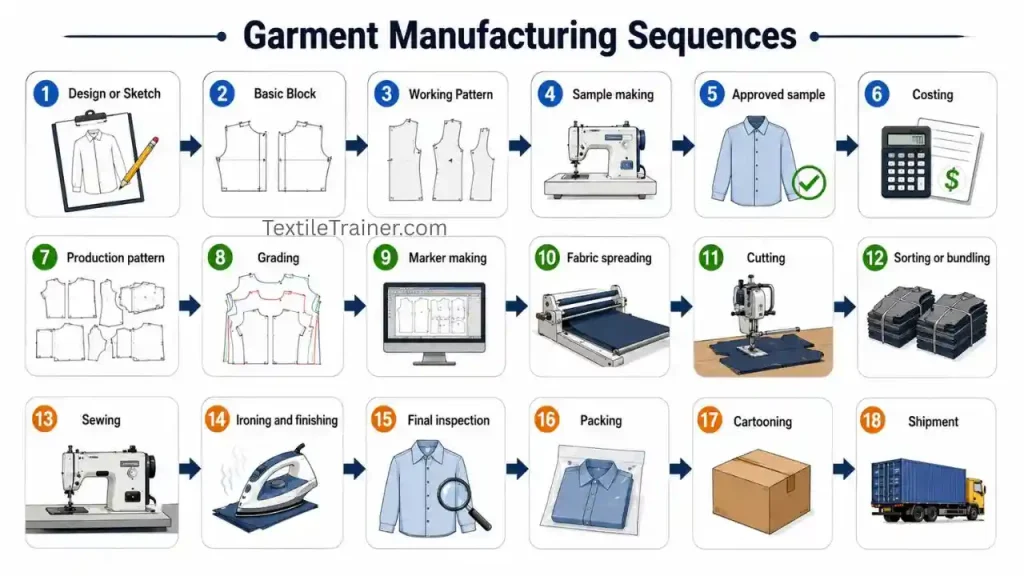
| Operation | Job | Method |
| 1. Design or Sketch | Design or sketching is the first stage in the garment manufacturing sequences. Design is given by the buyer to garment manufacturers. This garment design or sketch contains all the measurements of the style. | Design or sketch is done in two ways: manually or computerized. |
| 2. Basic Block | It is the second garment manufacturing step. It is made without any seam allowance | It is done manual/computerized. |
| 3. Working Pattern | A pattern is a hard copy of each component of a garment with the exact dimensions of each component. The working pattern also includes seam allowances, trimming allowances, dirt allowances, pleat allowances, ease allowances, and any special designs. | Patterns can also be designed manually or by computer. |
| 4. Sample making | A working pattern is sent to a sewing unit for assembly into a garment. It is usually stitched on calico or muslin, which is of inferior quality and costs less. The sample garment is stitched to analyze the fit of the pattern, and the buyer reviews it after it has been stitched for approval or correction. | Manual |
| 5. Approved sample | A sample is again sent to buyers after it has been corrected or modified. If the sample meets the buyer’s requirements, it is referred to as an approved sample. | Manual |
| 6. Costing | Now, calculate the full costing of garments, including fabric cost, making charge, trimmings, utility, and profits. | Manual |
| 7. Production pattern | Pattern designers are now creating production patterns. Production patterns are used for large-scale garment production. The pattern maker makes the patterns on pattern making paper. All allowance is added to the pattern with its net dimensions. | Manual/computerized |
| 8. Grading | The grading is another garment manufacturing sequences. The purpose of grading is to create patterns in different standard sizes. Grading a pattern means scaling it up or down so that it fits multiple sizes. Example: S, M, L, XL, XXL | Manual/computerized |
| 9. Marker making | Markers are thin pieces of paper that contain all the components for each size of a style. They are also useful for calculating fabric consumption. | Manual/computerized |
| 10. Fabric spreading | Fabric spreading refers to the process of arranging fabrics on the spreading table according to the length and width of the markers in stack form. The lay/fabric is normally limited to 6 inches high, but 4 to 5 inches high is safe. | Manual/computerized |
| 11. Cutting | The marker paper is placed carefully and accurately on the fabric lay/spread, and pinned to prevent it from moving or moving. To cut out the garment component based on the exact dimensions of each pattern in stack form, care must be taken to avoid cutting defects. | Manual/computerized |
| 12. Sorting or bundling | The garment components are sorted by size and color after the fabric is cut. To avoid mistakes, use a code number for each pattern to prevent mix-ups in sorting. | Manual |
| 13. Sewing | In the sewing process, different types of machines are used. At that point, quality inspection is also carried out. So, sewing is the most important garment manufacturing sequences. | Manual |
| 14. Ironing and finishing | Steam is used to treat garments. There are also several finishing processes, for example, cutting extra loose threads. | Manual |
| 15. Final inspection | Before packing, this is the last stage of inspection of the manufactured garments, performed by the manufacturer on behalf of its customers. | Manual |
| 16. Packing | As a final inspection is completed, the garments are poly-packed, dozen-by-dozen, color-by-color, size-by-size, and packaged in the Poly bag. | Manual |
| 17. Cartooning | After packing, the garments are placed in a hard paper box for export to minimize damage. The cartons contain all the information on them according to buyer specifications. | Manual |
| 18. Shipment | Now, the garments are ready for shipment. If everything is okay, they will be sent to the buyer. | Manual |
Why is the garment manufacturing process important?
- Garment manufacturing steps are important. Because the garment manufacturing process helps to improve garment quality, reduce production costs, and reduce fabric waste. Additionally, the garment manufacturing sequence helps to increase production efficiency and ensures on-time shipment. So, every manufacturer should follow the garment manufacturing steps to maximize their profit.
Department involved in the garment manufacturing flow-chart
| Merchandising department | Design section |
| Pattern-making section | Sampling section |
| Fabric store | Fabric cutting section |
| Sewing section | Quality control |
| Finishing section | Delivery section |
| Embroidering section (an extra department, if the factory works with decorative design) | Washing section (Denim wash, denim dyeing) |
Conclusion
These are the garment manufacturing sequences. Every department or step plays an important role in producing a good quality product. If you have any other questions about the garment manufacturing process, please drop your question in the comment box.
Reference
- Hossain, M. S. (2014). Introduction to Textile Engineering. Dhaka: Books Fair Publications.
- Kashem, P. M. (2022). Garments And Technology . Dhaka: University Campus .
- Md. Saiful Azam, M. A. (2022). An Introductory Knowledge About Garments Manufacturing Technology. Dhka: Books Fair .
You may read: