Yarn Twist Tester Easy Working Principle:ISO 2061
Experiment Name
Study on the Electronic Yarn Twist Tester/ Study on the working principle of the Electronic Yarn Twist Tester and yarn twisting method ISO 2061:2015 (E)
Introduction
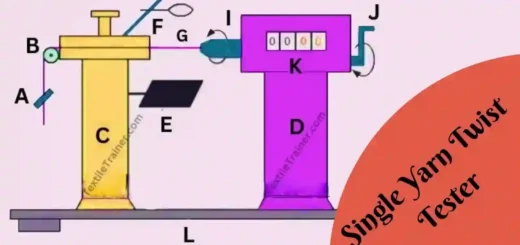
Yarn twist is one of the most crucial properties of yarn. Twist binds the fibers together and gives strength to the yarn. The yarn will break easily without proper twist. The yarn becomes hard and less flexible if the amount of twist is too high. However, a yarn twist tester is used to measure the amount of twist present in yarn. Generally, the result of the yarn twist tester is expressed as twist per inch (TPI) or twist per meter (TPM). The yarn twist tester works on the untwist-retwist principle. A yarn sample is held between two clamps. One clamp is fixed, and the other rotates. When the rotating clamp starts moving, it untwists the yarn. Gradually, the fibers become parallel. The machine counts the number of turns required to remove the twist. This number gives the twist value.
In some cases, the yarn is untwisted and then retwisted in the opposite direction to check the reading. Modern electronic yarn twist testers display the result automatically on a digital screen. The following are the different methods of determining the yarn twist test:
- Direct method: the straightened fiber method.
- Indirect method: Untwist-retwist method
- Double untwist-retwist method.
- Three-time untwist-retwist method
- The twist to break method.
- Optical method.
- Untwist method.
Lab Report: Wool Fiber Fineness Test by Optical Method Easy Way
Objective
- To know about yarn twist and its effect on yarn strength.
- To learn different methods of determining the yarn twist test.
- To know the electronic yarn twist tester.
Apparatus
- Double ply yarn.
- Electronic yarn twist tester.
- Magnifier
- Dissecting needle
- Standard weight
Yarn Twist Testing Method:
- ISO 2061: 2015(E)
- BS ISO 17202: 2002
- GB/T2543.2-2001
- ASTM D1423
- IS 832 (Part 2): 2011
Parts of the Electronic Yarn Twist Tester
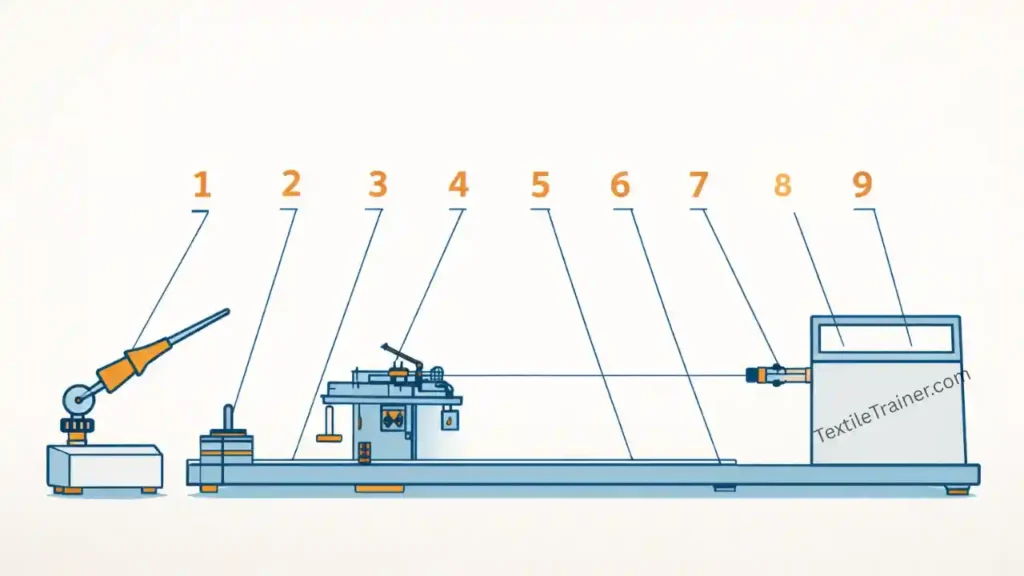
| 1= Yarn bobbin stand | 2= Tension weight | 3= Guide rail |
| 4= tension device | 5= Length scale | 6= Bottom plate |
| 7= Right yarn gripper | 8= Control box | 9= Ded frame foot |
Testing Procedure
The section of the electronic yarn twist testing procedure is divided into three parts. They are:
- Specimen preparation
- Pre-tension selection
- Working process
1. Specimen Preparation
Usually, twist is not distributed uniformly along the yarn. Hence, it interferes with the yarn twist result. To avoid this problem, the BSI method suggests a distance of 1 yard from one sample to another. Specimen length for electronic twist tester: 25, 50, 100, 200, 250, and 500 mm.
2. Pre-tension Selection
In many cases, the tension at which the specimen is clamped between the jaws of the twist tester affects the final test. Hence, this has to be standardized while testing. According to the ISO 2061:2015 (E), the recommended amount of tension is given below:
| Yarn type | Pre-tension value |
| All types of yarn except worsted | 0.50 cN/ Tex ± 0.10 |
| Pre-tension for worsted yarn depends on the twist factor. | Twist factor α<80, pre-tension is (0.10±0.02) cN/tex |
| Twist factor α<80~150, pre-tension is (0.25±0.05) cN/tex | |
| Twist factor α<150, pre-tension is (0.50±0.05) cN/tex |
3. Working Process of Electronic Yarn Twist Tester
- In this experiment, the gauge length is set to 500 mm. The yarn count is 14.8 tex, so the pretension weight is 7 cN.
- Set the tension weight on the left tension device.
- Turn on the machine.
- Draw the yarn from the bobbin stand using your right hand. Then press down the thread trapping lever with your left hand and guide the yarn into the yarn guide bar of the left yarn gripper.
- Release the thread trapping lever and remove the zero-position locating bracket. Hold the right yarn gripper with your left hand.
- Adjust the yarn so that when the pointer of the left gripper is at the zero position, the right yarn gripper holds the yarn properly.
- Set the program on the electronic twist tester:
- Test method: Direct method
- Twist direction: Anticlockwise (Z twist)
- Test speed: 800 RPM
- Preset twist: 50 (This is an estimated value based on the expected twist in the yarn)
- Untwist the yarn slightly by hand at the left side and insert the needle head. Then start the machine and slowly move the needle from left to right. This helps ensure the yarn is completely untwisted.
- When all twists are removed, stop the machine. The display will show the final result as twist per meter (TPM).
Yarn Twist Calculation
If manual calculation is required, the following formula can be used. Though the electronic yarn twist tester does not require any formula. Because the result of yarn twist in twist per meter shows directly in display of he electrtonic yarn twist tester.
- Twist per meter (TPM)= Number of turns ÷ Test length (m)
- Example:
- Number of turns= 225
- Test length= 500 mm= 0.5 m
- TPM= 225 ÷ 0.5= 450
| Electronic Twist Test Report | ||
| Material: Cotton yarn | Specimens no: 05 | Apparatus: Electronic twist tester |
| Sample form:Yarn package | Specimens(L): 500 mm | Yarn count: 14.8 tex |
| Pretension : 7 cN | Twist direction: Z twist | Date of Test: |
| Observation No | Twist per meter (TPM) | Average TPM |
| 01. | 450 | 451.2 |
| 02. | 448 | |
| 03. | 452 | |
| 04. | 458 | |
| 05. | 448 | |
The final result of yarn twist in twist per meter is 451.2
Precautions
- Yarn stretching should be avoided during twist testing.
- Proper pretension weight has to be used according to the test standard (ISO 2061: 2015).
- The sample should be conditioned before the test.
Conclusion
Twist is defined as the number of spiral turns given to a yarn to hold the constituent fibers together. In spinning factory, calculation of twist of yarn is crucial. Electronic twist tester is very simple device. It is easy to determine the twist per meter by using an electronic twist tester. This experiment will help in our future life. Thanks to our teacher for helping us.
Reference
- P. Angappan, R. G. (2009). Textile Testing. Tamil Nadu: S.S.M. Institute of Textile Technology.
- Booth, J. (2008). Principles of Textile Testing. New Delhi: BS Publishers & Distributors.
- Operation manual of electronic twister tester by GESTER
- BS ISO 17202:2002- Textiles-determination of twist in single spun yarns- untwist/retwist method.
- ISO 2061: 2015-Textiles-determination of twist in yarns-direct counting method.
Lab Report